
In today’s industrial landscape, the efficient movement of heavy loads across complex environments demands innovative solutions that go beyond traditional material handling systems. Omnidirectional steering technology represents a revolutionary advancement in this field, offering unprecedented maneuverability and control for heavy-duty platform trolleys and transporters. Unlike conventional steering systems that restrict movement to forward and backward directions with limited turning capabilities, omnidirectional systems enable complete 360-degree mobility, allowing vehicles to move sideways, diagonally, or rotate on their axis without repositioning.
For operations managers and industrial engineers working in energy, construction, and logistics sectors, understanding the comprehensive benefits of omnidirectional steering isn’t just about staying current with technology—it’s about transforming material handling processes to achieve new levels of efficiency, safety, and operational flexibility. MORELLO‘s approach to omnidirectional steering technology exemplifies how these systems can be optimized to deliver maximum value in demanding industrial applications.
The transformative advantages of omnidirectional steering technology
Omnidirectional steering represents a fundamental shift in how heavy loads are transported within industrial environments. Unlike conventional steering systems limited to forward, backward, and turning movements, omnidirectional technology enables complete freedom of movement in any direction without repositioning the vehicle. This capability transforms material handling operations in several critical ways.
The most immediate benefit is the ability to perform specialized steering actions that were previously impossible or extremely difficult with traditional systems. These include:
- Carousel movement: Rotating around the vehicle’s own center point
- Compass steering: Pivoting around a specific external point
- Crab steering: Moving sideways without changing the vehicle’s orientation
- Diagonal travel: Moving at any angle without multiple steering adjustments
These movement capabilities dramatically reduce the space needed for maneuvering, allowing heavy duty platform trolleys with steering systems to navigate through narrow aisles, tight corners, and congested work areas that would be inaccessible to conventional transporters. For facilities with space constraints or complex layouts, this translates to significant improvements in space utilization and workflow design flexibility.
Beyond spatial efficiency, omnidirectional steering substantially reduces the time required for positioning heavy loads with precision. Operations that previously required multiple back-and-forth movements can now be completed in a single, fluid motion, enhancing productivity while reducing operator fatigue and the risk of collisions in busy work environments.
How advanced wheel systems maximize operational efficiency
The engineering behind omnidirectional steering systems represents a significant advancement over conventional approaches, particularly in how the wheels are powered and controlled. In MORELLO’s cutting-edge implementation, every wheel features its own dedicated brushless electric traction motor with individual inverter control. This all-wheel drive architecture delivers substantial operational benefits that directly impact efficiency and reliability.
With each wheel independently powered and electronically controlled, the system maintains perfect synchronization of direction, acceleration, torque, and rotation speed across all contact points. This eliminates the common problem found in traditional systems where unpowered “trailer wheels” are simply dragged along, causing floor damage and creating resistance that increases power consumption and wear.
The fully-powered wheel configuration ensures optimal traction on all surface types, including sloped, wet, or slightly uneven floors. This prevents one of the most costly operational disruptions in heavy material handling: vehicle stoppage due to loss of traction. When a conventional transporter encounters an unexpected hole, slope change, or slippery patch, it may become immobilized, requiring expensive recovery equipment and causing significant workflow disruptions.
Advanced wheel systems also optimize energy efficiency despite powering more motors. By precisely controlling each wheel’s power output based on real-time movement requirements, the system eliminates wasted energy from wheel slippage or dragging. The brushless motor technology further enhances efficiency through regenerative braking capabilities, recovering energy during deceleration and extending battery life during intensive operations.
This sophisticated wheel management system translates directly to higher throughput, lower operational costs, and extended equipment lifespan in demanding industrial applications.
Weight distribution engineering: the hydraulic compensation advantage
One of the most sophisticated aspects of advanced omnidirectional steering systems is their approach to weight distribution through hydraulic compensation. This engineering feature fundamentally transforms how heavy loads interact with the supporting surface, creating significant operational and maintenance advantages.
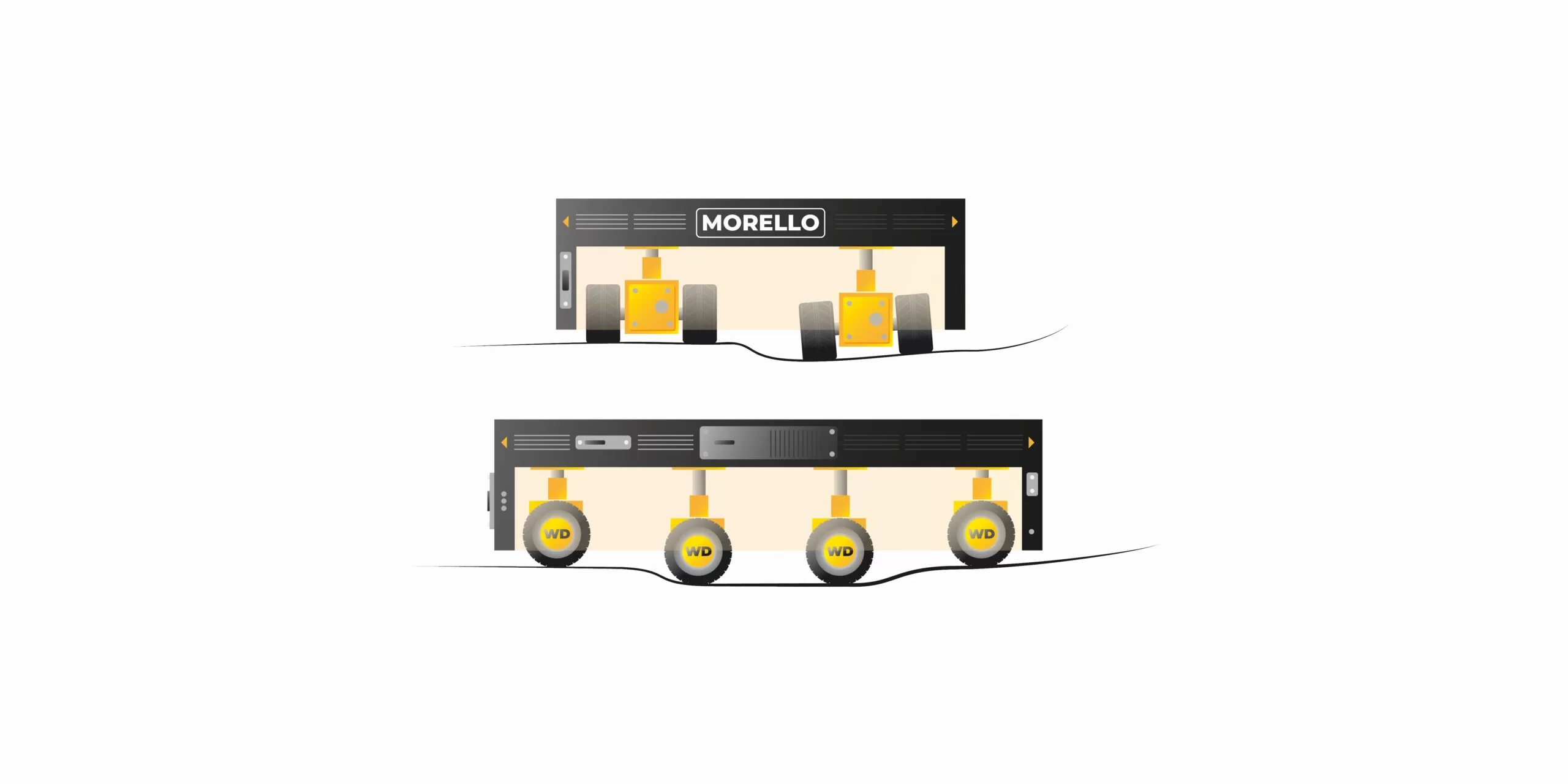
In MORELLO’s implementation, pairs of wheels oscillate on tilting axles, each supported by a hydraulic suspension cylinder. This design serves two critical functions: it dynamically balances weight across all wheels and provides lifting capabilities for the loading bed when required. The hydraulic system continuously adjusts to maintain optimal weight distribution regardless of load positioning or surface irregularities.
The key benefit of this approach is the creation of an isostatic balance system based on three points of stability. In physics and engineering, three points define a plane—the minimum required for stable support. By hydraulically linking the wheel pairs, the system effectively creates a three-point suspension that automatically conforms to the ground surface, ensuring all wheels maintain proper contact and share the load appropriately.
This stands in stark contrast to conventional systems that rely on rigid, hyperstatic designs with four or more fixed contact points. Such configurations cannot adapt to uneven surfaces—if one wheel encounters a depression or elevation change, some wheels inevitably lose contact or bear excessive weight. This creates dangerous instability, increases structural stress, and accelerates wear on both the vehicle and floor surfaces.
Beyond stability, the hydraulic compensation system enables precise control of the loading platform’s position. Operators can individually adjust each hydraulic point, allowing the platform to be leveled on uneven ground or deliberately tilted when needed for specific loading operations—capabilities impossible with rigid suspension systems.
Performance comparison: omnidirectional vs. conventional steering systems
When evaluating material handling solutions for heavy loads, understanding the performance differences between omnidirectional and conventional steering systems becomes crucial for making informed investment decisions. These differences manifest across several key operational parameters that directly impact productivity, safety, and total cost of ownership.
In terms of maneuverability, the contrast is stark. Conventional systems typically require three-point turns and multiple repositioning maneuvers to navigate tight spaces, with turning radiuses often exceeding 15 feet. Omnidirectional systems can rotate within their own footprint and move laterally without any forward/backward adjustment, reducing positioning time by up to 70% in complex environments.
Floor preservation represents another significant advantage. Traditional systems create substantial scrubbing and friction during turns, causing accelerated wear on industrial flooring. The specialized wheel arrangement in omnidirectional systems virtually eliminates this scrubbing effect, extending floor life and reducing facility maintenance costs. This becomes particularly valuable in environments with specialized or expensive flooring installations.
The precision placement capabilities also differ dramatically. Conventional systems typically achieve positioning accuracy within several inches, requiring manual adjustments for final placement. Advanced omnidirectional systems can achieve sub-inch precision through coordinated wheel control, enabling direct placement of loads in exact positions without secondary adjustments.
Perhaps most surprisingly, despite their technological sophistication, properly designed omnidirectional systems demonstrate superior reliability metrics. By eliminating complex mechanical linkages and hydraulic steering components in favor of electronic control systems and brushless motors, maintenance requirements are substantially reduced. This translates to fewer breakdowns, longer service intervals, and significantly higher uptime percentages compared to conventional heavy-duty transporters.
Implementing omnidirectional steering in complex industrial environments
Successfully integrating omnidirectional steering technology into existing industrial operations requires careful planning and consideration of facility-specific factors. The transition process begins with a comprehensive assessment of current material flow patterns, identifying bottlenecks and inefficiencies that could be addressed through enhanced maneuverability.
Facility layout analysis forms a critical component of the implementation strategy. While omnidirectional systems require significantly less maneuvering space than conventional transporters, optimizing facility design to take full advantage of their capabilities can multiply productivity benefits. This might involve reconfiguring production lines, storage areas, or transfer stations to capitalize on the system’s ability to move in any direction.
Operator training represents another key implementation consideration. While omnidirectional systems are ultimately more intuitive to control, operators accustomed to conventional steering will benefit from structured training programs that help them develop new mental models for spatial navigation. Most operators report a significant learning curve reduction once they understand the fundamental movement principles.
Integration with existing material handling processes must also be carefully managed. The transition often involves temporary parallel operations of both conventional and omnidirectional systems. Developing clear protocols for handoffs between different transport systems ensures smooth workflow during the implementation phase.
For facilities considering automation pathways, omnidirectional steering provides an excellent foundation for future development. The precise electronic control of all wheel functions makes these systems ideal candidates for progressive automation, from operator-assist features to fully autonomous operation. Many industrial facilities begin with manually operated omnidirectional systems and gradually implement sensors, guidance systems, and autonomous capabilities as operational confidence grows.
Elevating material handling through advanced steering innovation
The benefits of omnidirectional steering technology extend far beyond simple maneuverability improvements, fundamentally transforming how heavy materials are moved in industrial environments. By implementing these advanced systems, operations managers can simultaneously enhance safety, increase productivity, reduce facility damage, and lower maintenance costs. The hydraulic compensation system, independently powered wheels, and sophisticated electronic controls work in concert to overcome the limitations that have traditionally constrained heavy material handling operations.
As industrial facilities face increasing pressure to maximize efficiency while maintaining flexibility, omnidirectional steering systems provide a compelling solution that addresses both immediate operational challenges and future automation needs. MORELLO’s expertise in custom-engineered material handling solutions makes us an ideal partner for industries seeking to leverage these advanced technologies. Contact our engineering team today to discuss how our omnidirectional heavy-duty platform trolleys can be tailored to your specific operational requirements and transform your material handling capabilities.