
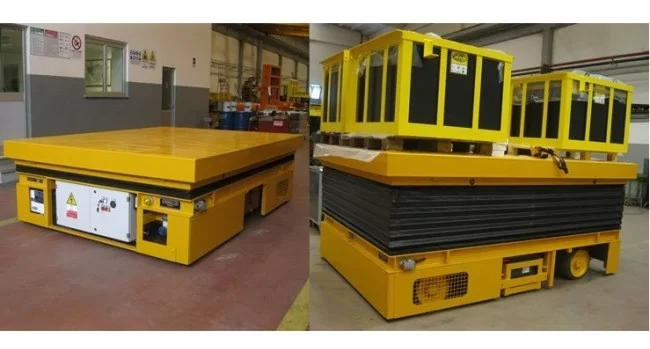
In today’s industrial landscape, efficient material handling is crucial for maintaining productivity and operational excellence. Self-propelled trailers with integrated lifting platforms represent a significant advancement in heavy load transportation technology, combining mobility and lifting capabilities in a single versatile unit. These specialized vehicles are engineered to address the complex challenges faced by industries that regularly move substantial weights across manufacturing facilities, construction sites, and logistical hubs. MORELLO’s latest innovation, the SGAI VSF-E self-propelled trailer, exemplifies this technology with its impressive 10-ton capacity and customized lifting platform measuring 3000 x 2100 mm with a 500 mm stroke. This integration of transportation and elevation functions eliminates the need for separate lifting equipment, streamlining operations and reducing handling time. For industrial engineers and operations directors working in energy, construction, and logistics sectors, understanding the capabilities and applications of these advanced systems is essential for optimizing material flow and enhancing workplace efficiency.
Understanding self-propelled trailers with integrated lifting platforms
Self-propelled trailers with integrated lifting platforms represent a sophisticated evolution in material handling equipment, combining mobility and elevation capabilities in a single unit. Unlike conventional trailers that require separate towing vehicles and additional lifting machinery, these integrated systems operate autonomously with their own power source and built-in lifting mechanisms.
At their core, these specialized vehicles feature a robust platform mounted on a self-propelled chassis, equipped with a hydraulic lifting system that enables vertical movement of the load. The design typically incorporates precision hydraulic cylinders, stabilizing outriggers, and sophisticated control systems that ensure safe and accurate positioning of heavy materials.
The integration of propulsion and lifting functions offers several fundamental advantages:
- Operational efficiency – Eliminates the need for multiple pieces of equipment and reduces handling steps
- Space optimization – Requires less maneuvering area compared to separate towing and lifting equipment
- Enhanced precision – Provides greater control during both transport and elevation phases
- Streamlined workflow – Enables seamless transitions between moving and lifting operations
Modern self-propelled trailers with lifting platforms like MORELLO’s SGAI VSF-E model feature advanced control systems that allow operators to manage movement and lifting functions from a single interface, often with remote control capabilities for improved visibility and safety. These systems are engineered with redundant safety features to prevent accidents during lifting operations, including load sensors, stability monitoring, and emergency shutdown mechanisms.
Technical specifications and capabilities of industrial lifting trailers
The performance parameters of industrial self-propelled trailers with lifting capabilities vary widely based on their intended applications, but several key technical specifications determine their operational effectiveness. Taking MORELLO’s SGAI VSF-E model as a reference point, we can examine the critical engineering aspects that define these specialized vehicles.
Load capacity represents the primary specification, with industrial models typically ranging from 5 to 50 tons. The SGAI VSF-E exemplifies mid-range capability with its 10-ton capacity, suitable for handling substantial industrial components while maintaining maneuverability. Platform dimensions constitute another crucial factor, with the 3000 x 2100 mm surface area of this model providing ample space for accommodating oversized loads while remaining compact enough for indoor facility navigation.
Lifting stroke—the vertical distance the platform can travel—significantly impacts versatility. The 500 mm stroke featured in the SGAI VSF-E enables alignment with various loading docks, production stations, and transport vehicles without requiring additional adjustment equipment. Propulsion systems typically employ electric motors powered by industrial batteries for indoor applications, or diesel engines for outdoor use where emissions restrictions are less stringent.
Control systems have evolved substantially, with modern trailers featuring:
- Advanced hydraulic systems provide precise lifting control with multi-stage cylinders that maintain platform stability throughout the elevation range.
- Safety features include load distribution sensors, automatic shutdown mechanisms when detecting imbalance, and emergency lowering systems that function even during power failure.
- The drive systems typically offer variable speed control with regenerative braking that captures energy during deceleration, extending battery life in electric models.
Applications across industries: where these specialized vehicles excel
Self-propelled trailers with integrated lifting platforms demonstrate exceptional versatility across numerous industrial sectors, each leveraging the equipment’s dual functionality to address specific operational challenges. In the energy sector, these specialized vehicles have become indispensable for handling heavy generators, turbine components, and transformer units during both installation and maintenance phases. The ability to transport and precisely position these critical components without requiring separate cranes significantly reduces project timelines and minimizes the risk of damage during handling.
Manufacturing facilities, particularly those producing large machinery or prefabricated structures, utilize these integrated systems to move work-in-progress between production stations. The lifting capability enables seamless transitions between assembly lines operating at different heights, eliminating bottlenecks and maintaining production flow. Aerospace manufacturers particularly benefit from the precision positioning these platforms offer when aligning aircraft sections during assembly.
In the construction industry, self-propelled lifting trailers excel at transporting and positioning precast concrete elements, structural steel components, and modular building sections. Their maneuverability in confined construction sites provides advantages over traditional cranes, especially for interior work or projects with overhead restrictions. The integrated design allows for transportation through standard doorways followed by precise elevation to installation height.
Logistics centers and distribution facilities employ these vehicles for loading/unloading operations where dock heights vary or where floor-level access is required. The self-propelled nature eliminates the need for dedicated tow vehicles in congested warehouse environments, while the lifting function enables direct loading onto trucks or storage racks without additional equipment. This dual capability proves particularly valuable in cross-docking operations where rapid transfer between transport modes is essential for maintaining supply chain efficiency.
Key advantages over traditional material handling solutions
When comparing self-propelled trailers with integrated lifting platforms to conventional material handling approaches, several distinct advantages emerge that explain their growing adoption across industrial sectors. Traditional methods typically require combinations of separate equipment—forklifts, cranes, tow tractors, and trailers—each with dedicated operators and coordination requirements. This fragmented approach creates multiple handover points where delays and safety risks concentrate.
The integrated design of self-propelled lifting trailers delivers substantial operational efficiencies through equipment consolidation. A single unit performs both horizontal transport and vertical positioning, reducing capital investment in multiple machines and decreasing maintenance requirements. Labor utilization improves dramatically as operations that previously required multiple operators can now be executed by a single skilled technician, often using remote controls that enhance visibility and safety.
Workflow optimization represents another significant advantage. The elimination of transfer points between transport and lifting equipment reduces handling time by up to 40% in typical applications. This streamlined process not only accelerates operations but also minimizes the risk of product damage during multiple handling steps. The ability to execute continuous operations without waiting for auxiliary equipment improves scheduling predictability and resource allocation.
Space utilization benefits cannot be overstated, particularly in facilities with limited operating areas. The compact footprint of these integrated systems requires significantly less maneuvering space than separate towing and lifting equipment combinations. This spatial efficiency translates directly to increased productive floor area and improved facility layout options. Additionally, the precise maneuverability of self-propelled systems enables navigation through congested spaces that would be inaccessible to conventional material handling trains.
From a financial perspective, the total cost of ownership often proves more favorable despite higher initial investment, as the reduced labor requirements, lower maintenance costs, and operational efficiencies deliver compelling long-term returns.
Customization options for specific operational requirements
The effectiveness of self-propelled trailers with integrated lifting platforms stems largely from their adaptability to specific industrial challenges. MORELLO’s approach to customization exemplifies how these specialized vehicles can be tailored to address unique operational requirements across diverse applications.
Platform configuration represents the most visible customization aspect. While standard rectangular platforms serve many applications, specialized designs include V-shaped cradles for cylindrical objects, notched surfaces for irregular components, and modular extensions for oversized loads. Surface treatments vary from high-friction coatings that prevent load shifting to cushioned materials that protect delicate items during transport.
Propulsion systems can be customized based on operating environment and duty cycle. Electric drives with enhanced battery capacity suit intensive indoor operations, while hybrid systems combine the emissions advantages of electric power with the extended runtime of diesel generators. For environments with explosive atmospheres, intrinsically safe propulsion systems incorporate sealed electronics and spark-prevention measures that comply with hazardous area classifications.
Control interfaces range from basic pendant controllers to sophisticated touchscreen systems with integrated load management software. Remote operation capabilities can be enhanced with camera systems providing multiple viewing angles, particularly valuable when handling oversized loads with limited visibility. For facilities with existing automation infrastructure, control systems can be integrated with factory management software for coordinated operation and production tracking.
Specialized lifting mechanisms address unique handling requirements beyond simple vertical movement. Scissor lift configurations provide stable platforms with minimal height when retracted, while telescopic lifts offer extended vertical reach in confined spaces. Tilt mechanisms allow controlled angular positioning for specialized loading operations or component alignment during assembly processes.
Environmental adaptations extend operational capability across challenging conditions. Climate-controlled enclosures protect sensitive components in extreme temperatures, while sealed systems enable operation in dusty or corrosive environments. For outdoor applications, all-terrain undercarriages with enhanced ground clearance and specialized tires maintain functionality on unpaved surfaces and inclines.
Transforming material handling through integrated technology
Self-propelled trailers with integrated lifting platforms represent a significant evolution in industrial material handling, combining transportation and positioning capabilities in unified, efficient systems. These specialized vehicles deliver tangible operational benefits across energy, manufacturing, construction, and logistics sectors through their versatility, precision, and streamlined workflow capabilities. As industries continue to seek productivity improvements and operational efficiencies, these integrated solutions offer compelling advantages over traditional equipment combinations.
MORELLO’s expertise in designing and manufacturing customized material handling solutions, exemplified by innovations like the SGAI VSF-E self-propelled trailer with integrated lifting platform, demonstrates the potential for these technologies to address complex industrial challenges. By consolidating functions and enhancing operational capabilities, these systems help organizations optimize their material flow while improving safety and reducing handling costs.
Ready to explore how self-propelled trailers with integrated lifting capabilities can transform your heavy load handling operations? Contact MORELLO’s engineering team today to discuss your specific requirements and discover customized solutions for your most challenging material handling needs.