
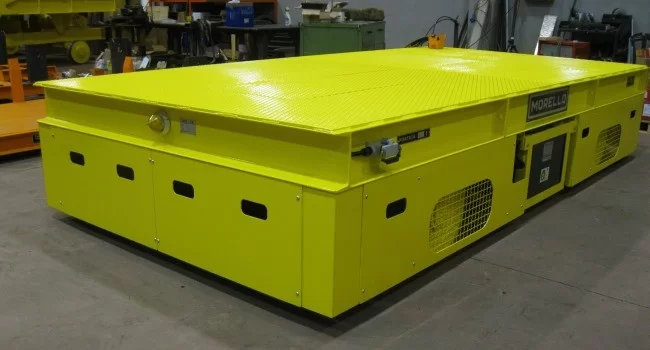
When it comes to moving exceptionally heavy loads in industrial environments, traditional methods often fall short of meeting modern efficiency demands. Battery-powered self-propelled trailers represent the cutting edge of material handling technology, offering unprecedented mobility and control for loads that once required complex rigging systems or multiple pieces of equipment.
These innovative transportation solutions are transforming operations across automotive manufacturing, energy production, construction, and heavy logistics sectors. With load capacities reaching 50 tons and beyond, these specialized trailers combine powerful electric propulsion with precision maneuverability, eliminating the need for external towing vehicles while reducing operational footprints. For industrial engineers and operations directors tasked with optimizing material movement in complex facilities, understanding the capabilities and applications of these advanced systems is essential for maintaining competitive advantages in production efficiency and workplace safety.
The evolution of battery-powered self-propelled trailers for industrial material handling
Industrial material handling has undergone remarkable transformation with the introduction of battery-powered self-propelled trailers. These specialized vehicles emerged as a response to the growing challenges of moving exceptionally heavy loads across manufacturing facilities, construction sites, and logistics centers. Initially, heavy load transportation relied exclusively on diesel-powered equipment or complex towing systems that required significant manpower and space to operate effectively.
The breakthrough came with the development of high-capacity electric drive systems that could be integrated directly into trailer platforms. This innovation eliminated the need for separate towing vehicles while simultaneously reducing emissions and operational noise. Early models featured basic directional control systems, but modern battery-powered self-propelled trailers now incorporate sophisticated electronic steering mechanisms, allowing for precise maneuverability in confined spaces.
Perhaps the most significant advancement has been in battery technology. Contemporary lithium-ion power systems have replaced older lead-acid batteries, dramatically extending operational times while reducing charging intervals. This technological leap has made 50-ton capacity self-propelled battery trailers not just feasible but increasingly common in industries where continuous operation is essential.
The evolution continues with the integration of smart technologies, including remote operation capabilities, obstacle detection systems, and programmable movement paths that further enhance safety and efficiency in industrial environments where space constraints and hazardous conditions present ongoing challenges.
Technical innovations: how 50-ton capacity trailers work
The engineering behind a 50-ton capacity self-propelled battery-powered trailer represents a masterclass in industrial design. These powerful machines combine multiple technical innovations to create seamless heavy load transportation systems that can operate in challenging environments.
At the heart of these trailers lies a sophisticated power management system. Multiple high-torque electric motors, typically positioned at strategic points within the chassis, provide the necessary propulsion. These motors connect to heavy-duty wheel assemblies through specialized gear reduction systems that maximize torque while maintaining precise speed control. The distributed drive configuration ensures that power delivery remains balanced across the entire platform, preventing structural stress points even when carrying maximum loads.
The battery systems in modern self-propelled trailers utilize advanced chemistry that optimizes power density. A typical 50-ton capacity unit houses multiple battery banks that can deliver sustained power for operational periods of 6-8 hours before requiring recharging. Temperature management systems protect these batteries during high-demand operations, extending their service life while maintaining consistent performance.
Control systems represent another critical innovation. Operators interface with these massive machines through intuitive control panels that provide proportional speed control, directional steering, and real-time diagnostic information. Many advanced models incorporate wireless remote control capabilities, allowing operators to maintain visual contact with the load and surrounding environment while controlling the trailer from a safe distance.
The platform itself features reinforced structural elements designed through finite element analysis to distribute weight evenly while maintaining the necessary flexibility to navigate uneven surfaces without compromising stability.
Key applications and industry-specific benefits
Battery-powered self-propelled trailers have found their niche across numerous industrial sectors, each benefiting from specific capabilities these specialized vehicles offer. In the automotive manufacturing industry, these trailers excel at transporting large vehicle components, dies, and tooling equipment between production stations. The precise maneuverability allows assembly line reconfigurations without the space requirements of traditional towing equipment.
The energy sector relies heavily on these trailers for moving turbine components, generator assemblies, and transformer units within power generation facilities. The battery-powered operation eliminates emissions, making them ideal for indoor use where air quality concerns are paramount. For nuclear facilities, these trailers provide the added benefit of operating without combustion engines in sensitive environments where fire risks must be minimized.
In aerospace manufacturing, where components can be both massive and delicate, self-propelled trailers offer smooth acceleration and deceleration profiles that protect high-value payloads from sudden movements. The adjustable speed control allows operators to move multi-million dollar components with confidence.
Construction and precast concrete industries benefit from these trailers’ ability to navigate unpaved surfaces while maintaining stability. The distributed weight bearing capability prevents damage to finished floors when moving heavy structural elements inside partially completed buildings.
Perhaps most impressively, logistics and warehousing operations utilize these trailers to maximize storage density. The omnidirectional steering capabilities available on advanced models allow palletized goods to be positioned in tight spaces that would be inaccessible to conventional forklifts or tow tractors, significantly increasing warehouse capacity without facility expansion.
Comparing battery-powered trailers to traditional heavy load transportation methods
When evaluating material handling options for heavy loads, operations directors must consider how battery-powered self-propelled trailers stack up against conventional transportation methods. The most immediate comparison is with tractor-trailer systems, which have long been the standard for moving substantial weights across industrial facilities.
The operational footprint represents one of the most significant differences. A traditional tractor-trailer combination requires considerable space for maneuvering, particularly when navigating turns or positioning loads in confined areas. In contrast, battery-powered self-propelled trailers can execute zero-radius turns and lateral movements, requiring up to 40% less operational space.
From a labor perspective, self-propelled trailers typically require fewer personnel. While tractor-trailer systems often need both a driver and spotters to navigate safely, a single operator can control a battery-powered trailer, even remotely for complex movements. This staffing efficiency translates to measurable cost savings over time.
Environmental considerations also favor battery-powered options. Unlike diesel tractors that produce emissions and require ventilation systems when operating indoors, electric trailers generate zero local emissions. This characteristic eliminates the need for expensive air handling equipment and creates healthier working environments.
Maintenance profiles differ substantially as well. Combustion engines in traditional tractors require regular service intervals with numerous consumable parts and fluids. Electric drive systems in self-propelled trailers have significantly fewer moving components, reducing maintenance frequency and associated downtime. While the initial investment for a battery-powered self-propelled trailer typically exceeds that of a conventional system, the total cost of ownership calculations often favor the electric option when factoring in operational efficiencies and reduced maintenance requirements.
Future-proofing industrial operations with advanced self-propelled trailer technology
As industrial facilities evolve toward greater automation and connectivity, battery-powered self-propelled trailers are increasingly becoming central to forward-thinking material handling strategies. These advanced transportation systems offer a clear pathway toward future-proofed operations through several key technological developments.
Integration with facility management systems represents one of the most promising advancements. Modern self-propelled trailers can be equipped with telemetry packages that communicate with centralized control systems, providing real-time location data, battery status, and maintenance requirements. This connectivity allows operations managers to optimize material flow throughout facilities, identifying bottlenecks and implementing data-driven improvements.
The transition toward semi-autonomous operation capabilities signals another significant development. Advanced sensor arrays—including LiDAR, computer vision, and ultrasonic detection—are being incorporated into trailer designs, enabling obstacle avoidance and predetermined path following without continuous operator intervention. These features serve as stepping stones toward fully autonomous operation, where trailers will eventually navigate complex industrial environments independently.
Energy management innovations continue to extend operational capabilities. Rapid charging technologies and hot-swappable battery systems minimize downtime, while regenerative braking recovers energy during deceleration. Some manufacturers now offer solar charging options for facilities with appropriate infrastructure, further reducing operational costs and environmental impact.
Perhaps most importantly, modular design approaches allow for component upgrades without replacing entire trailer systems. This adaptability ensures that investments in battery-powered self-propelled trailer technology can evolve alongside changing operational requirements, protecting capital expenditures while maintaining competitive advantages in heavy material handling efficiency.
Transforming industrial material handling with innovative trailer solutions
Battery-powered self-propelled trailers represent a significant leap forward in heavy load handling technology, offering industrial operations a powerful combination of efficiency, flexibility, and sustainability. With capacities reaching 50 tons and beyond, these specialized vehicles eliminate many of the limitations associated with traditional material transportation methods while providing a clear path toward future automation capabilities. As manufacturing, energy, construction, and logistics sectors continue to face increasing demands for operational efficiency, these advanced trailers deliver measurable advantages in both immediate productivity and long-term adaptability.
MORELLO‘s expertise in custom-engineered material handling solutions makes us the ideal partner for organizations seeking to optimize their heavy load transportation systems. Our engineering team specializes in developing battery-powered self-propelled trailers tailored to your specific operational requirements, facility constraints, and load characteristics.
Contact MORELLO today to discuss how our innovative trailer technology can transform your material handling processes and deliver sustainable competitive advantages for your industrial operations. Explore our customized handling solutions and take the first step toward operational excellence.