
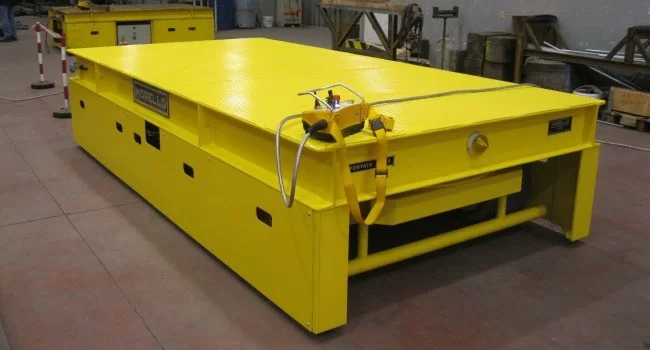
In today’s industrial environments, efficient material handling is critical for maintaining productivity and operational excellence. Electric transfer cars represent a significant advancement in the field of heavy load transportation, offering a versatile and efficient solution for moving substantial materials across manufacturing facilities, warehouses, and production plants. These specialized vehicles are designed to handle loads ranging from several tons to over 35 tons, providing reliable performance in demanding industrial settings.
MORELLO, a global leader in custom material handling equipment, has perfected the design and implementation of electric transfer cars that combine power, precision, and sustainability. These self-propelled vehicles are revolutionizing how industries approach material movement challenges, especially in sectors where traditional handling methods prove inadequate for oversized or exceptionally heavy components. This article explores the capabilities, benefits, and applications of electric transfer cars in modern industrial material handling operations.
Understanding electric transfer cars in modern material handling
Electric transfer cars represent a sophisticated evolution in industrial material handling technology. These specialized vehicles operate on battery power, eliminating emissions while providing robust capabilities for transporting heavy loads across manufacturing facilities, warehouses, and production environments. Unlike conventional forklifts or manual transport systems, electric transfer cars are designed specifically for horizontal movement of exceptionally heavy or bulky materials that would otherwise require multiple handling equipment or complex rigging.
The fundamental design of these vehicles includes a low-profile platform mounted on wheels or rails, powered by high-capacity batteries that drive electric motors. This configuration allows for precise positioning and controlled movement of loads that can exceed 35 tons. The operator interface typically features intuitive controls that enable single-person operation despite the substantial weight being transported.
What distinguishes electric transfer cars in the material handling ecosystem is their versatility across different industrial applications. They can be customized with various steering systems—including fixed-path, steerable, and omnidirectional configurations—to navigate tight spaces and complex facility layouts. This adaptability makes them invaluable in industries where production layouts may change or where materials must move through congested spaces.
Their silent operation and zero emissions also make them appropriate for indoor use where air quality and noise concerns exist, providing advantages over diesel or gas-powered alternatives while maintaining comparable power capabilities.
Key features and capabilities
Modern electric transfer cars incorporate several advanced features that make them indispensable for industrial material handling operations. MORELLO’s engineering expertise has resulted in vehicles that balance power, control, and efficiency in ways that transform heavy load movement processes.
The load capacity of these specialized vehicles is perhaps their most impressive characteristic. Capable of handling weights up to 35 tons and beyond, they provide reliable transport solutions for even the most demanding industrial applications. This capability is delivered through robust structural design and optimized weight distribution that ensures stability during operation.
Battery technology represents another critical component. High-capacity lithium-ion or industrial lead-acid battery systems power these vehicles through full production shifts without requiring frequent recharging. The battery systems are engineered for rapid charging when needed, minimizing downtime and maintaining operational continuity.
Control systems in modern electric transfer cars offer precision that was previously unattainable with conventional handling equipment. Variable speed controls, proportional steering, and programmable movement parameters allow operators to execute precise maneuvers even with massive loads. Many models feature remote control capabilities, enabling a single operator to safely manage the movement of substantial materials from an optimal vantage point.
Safety features are comprehensively integrated, including emergency stop functions, obstacle detection sensors, warning lights, and audible movement signals. These systems work in concert to protect both operators and surrounding personnel while safeguarding the valuable materials being transported.
Customization options extend to the platform dimensions, steering configurations, and integration capabilities with existing production systems, making each vehicle adaptable to specific operational requirements.
Comparing electric transfer cars to traditional material handling systems
When evaluating material handling options for heavy industrial loads, understanding the comparative advantages of electric transfer cars becomes essential. Traditional systems like overhead cranes, forklifts, and tractor-trailer combinations have long dominated the industry, but electric transfer cars offer distinctive benefits that address specific operational challenges.
Unlike overhead crane systems, which require extensive ceiling infrastructure and present limitations in movement paths, electric transfer cars operate at ground level with flexible routing options. This eliminates the substantial structural requirements and fixed pathways that characterize crane installations. For facilities with ceiling height constraints or those needing to reconfigure production layouts frequently, this ground-level operation provides significant advantages.
Compared to conventional tractor-trailer systems, electric transfer cars offer superior maneuverability in confined spaces. The self-contained design eliminates the turning radius concerns associated with articulated tractor-trailer combinations, allowing for precise positioning in tight production areas where space optimization is critical.
Traditional forklift operations for extremely heavy loads often require multiple vehicles working in coordination, creating synchronization challenges and increasing accident risks. Electric transfer cars consolidate this function into a single unit capable of handling what might otherwise require several forklifts, streamlining operations and reducing labor requirements.
From an environmental perspective, electric transfer cars produce zero emissions at the point of use, unlike diesel-powered alternatives. This makes them suitable for indoor operations where air quality is a concern, eliminating the need for extensive ventilation systems that might otherwise be required for combustion-engine equipment.
The operational efficiency gains from implementing electric transfer cars often translate to measurable productivity improvements, particularly in operations where material movement represents a significant workflow bottleneck.
Application scenarios across different industrial sectors
Electric transfer cars for industrial material handling demonstrate remarkable versatility across numerous sectors, each benefiting from their specialized capabilities in unique ways. MORELLO’s implementation experience spans global industries with diverse requirements and operational conditions.
In the automotive manufacturing sector, electric transfer cars excel at transporting large body components, engine blocks, and completed chassis between production stations. Their precise positioning capabilities ensure alignment with assembly fixtures, while their gentle acceleration prevents damage to partially completed vehicles. One notable application involves the movement of complete car bodies through paint preparation areas where environmental controls are critical and emissions must be eliminated.
The aerospace industry utilizes these vehicles for handling oversized components such as wing assemblies, fuselage sections, and landing gear systems. The ability to customize platform dimensions allows for secure transportation of irregularly shaped components that would be challenging for conventional handling equipment.
Within steel and metal processing facilities, electric transfer cars transport heavy coils, plates, and beams between processing stations. Their stable platforms prevent material shifting during transport, while their electric drive systems eliminate contamination concerns in sensitive metallurgical processes.
The precast concrete industry benefits from electric transfer cars for moving massive structural elements from production to curing areas and ultimately to storage or loading zones. The high weight capacity accommodates concrete elements weighing many tons without requiring multiple handling steps.
Energy sector applications include the transportation of turbine components, generator housings, and transformer assemblies within manufacturing and maintenance facilities. The precision control allows for careful positioning of these sensitive and valuable components.
Logistics and distribution centers implement electric transfer cars for moving consolidated loads between loading areas, optimizing space utilization while reducing the need for multiple handling equipment pieces operating in congested spaces.
Maximizing efficiency with customized electric transfer solutions
The true potential of electric transfer cars is realized through customization that aligns precisely with specific operational requirements. MORELLO’s approach to designing these specialized vehicles begins with a comprehensive analysis of the material flow, facility layout, and handling challenges unique to each client’s environment.
Platform dimensions represent a critical customization factor, with width, length, and load-bearing surface configurations tailored to accommodate specific materials. For clients handling irregularly shaped components, custom fixtures and securing mechanisms can be integrated directly into the transfer car design, eliminating the need for separate restraint systems.
Drive system optimization balances power requirements with energy efficiency considerations. By analyzing the actual load weights, transport distances, and cycle frequencies, engineers can specify motor and battery configurations that deliver necessary performance while minimizing energy consumption and maximizing operational runtime between charges.
Control interfaces can be customized based on operator preferences and safety protocols. Options range from traditional onboard controls to wireless remote systems and even semi-autonomous operation capabilities that follow predetermined paths through production areas. These control variations significantly impact workflow efficiency and operator productivity.
Integration with existing facility systems represents another customization dimension. Electric transfer cars can be designed to interface with production control systems, providing real-time location and status data that supports overall production scheduling and material flow optimization. This connectivity enables predictive maintenance scheduling and performance analytics that further enhance operational efficiency.
Safety system customization addresses specific environmental risks and company protocols. From standard features like perimeter sensors and warning signals to specialized systems that interact with facility access controls, these safety adaptations ensure that the transfer solution complements existing workplace safety frameworks.
Through this multifaceted customization approach, electric transfer cars transform from general material handling equipment into precision-engineered solutions that address the exact challenges of each industrial application.
Elevating industrial material handling with advanced electric transfer technology
Electric transfer cars have fundamentally transformed industrial material handling operations by providing a powerful combination of capacity, precision, and adaptability. As manufacturing and logistics operations continue to evolve toward greater efficiency and sustainability, these specialized vehicles offer solutions that address the most challenging aspects of heavy material movement. MORELLO’s commitment to engineering excellence ensures that each electric transfer car delivers optimal performance within its specific operational context, whether in automotive manufacturing, aerospace production, or energy sector applications.
The competitive advantages gained through implementing these advanced handling systems extend beyond mere material movement to impact overall production efficiency, workplace safety, and environmental responsibility. By partnering with a recognized leader in custom material handling solutions, industrial operations can overcome their most significant transportation challenges while positioning themselves for future growth and adaptation.
Ready to revolutionize your heavy material handling operations? Contact MORELLO today to discuss how our customized electric transfer cars can transform your industrial material movement challenges into operational advantages.