
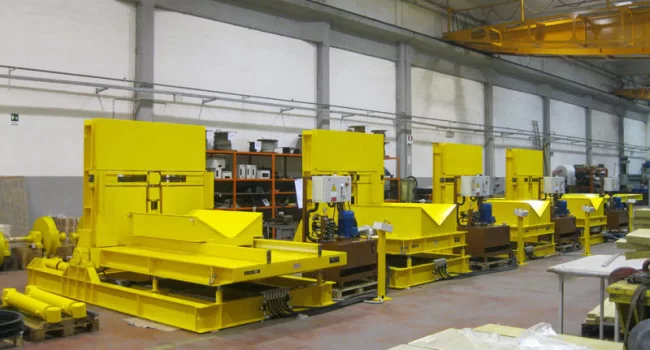
In modern steel processing facilities, efficient material handling is critical to maintaining production flow and worker safety. High-capacity coil tilters represent a cornerstone technology for operations that regularly manage heavy steel coils. These specialized systems enable the precise rotation of massive steel coils from horizontal to vertical positions (or vice versa), facilitating seamless transitions between processing stages. As steel coils often weigh several tons and present significant handling challenges, these robust tilting mechanisms provide controlled movement that protects both valuable materials and personnel.
MORELLO‘s advanced electrohydraulic coil tilters exemplify engineering excellence in this domain, offering solutions capable of handling loads up to 10 tons with remarkable precision. Whether integrated into automated production lines or utilized as standalone equipment, high-capacity coil tilting systems have become indispensable assets for steel manufacturers seeking to optimize their material handling processes while maintaining stringent safety standards.
Understanding high-capacity coil tilters in steel manufacturing
In the steel industry, material handling presents unique challenges due to the weight, dimensions, and sensitivity of steel coils. High-capacity coil tilters are specialized machines designed to rotate heavy steel coils between horizontal and vertical positions, facilitating various manufacturing processes. These robust systems serve as critical interfaces between production stages in modern steel facilities.
The fundamental function of these tilters is straightforward yet essential: they provide controlled rotation of coils that often weigh between 5 and 10 tons—sometimes even more. Without these systems, transitioning coils between processing stations would require multiple crane operations, increasing handling time and safety risks.
What distinguishes high-capacity tilters from standard material handling equipment is their precision despite managing enormous loads. The tilting mechanism typically employs hydraulic or electrohydraulic systems that deliver smooth, controlled movement through a 90° arc. This controlled motion prevents damage to the coil edges and surfaces, which is particularly important for high-grade steel products where surface integrity directly impacts quality.
Most industrial coil tilters feature reinforced saddles designed to accommodate various coil dimensions and weights. The saddle configuration often includes centering mechanisms that automatically position the coil correctly before tilting begins, ensuring balanced rotation and preventing operational hazards.
These systems represent a critical investment for steel processors looking to optimize their production flow while maintaining strict quality control and safety standards throughout their operations.
Technical specifications and capabilities of industrial coil tilters
When examining high-capacity coil tilting systems for steel industries, understanding their technical specifications becomes crucial for selecting appropriate equipment. Industrial coil tilters vary significantly in their design and capabilities, with several key parameters determining their suitability for specific applications.
Load capacity stands as the primary specification, with modern industrial tilters typically handling between 5 to 10 tons as standard configurations. For specialized applications, custom-built systems can accommodate loads exceeding 15 tons. MORELLO’s advanced tilters, for instance, offer precise handling of 10-ton coils with remarkable stability throughout the rotation cycle.
Dimensional considerations also play a vital role in tilter selection. Standard units feature platforms measuring approximately 1900mm × 1870mm, with height specifications around 2000mm. For larger coils, extended platforms reaching dimensions of 3175mm × 1870mm provide necessary accommodation while maintaining operational integrity.
The tilting mechanism itself typically employs one of two configurations:
- Fixed saddle systems – Offering robust support for standard operations with consistent coil dimensions
- Motorized saddle systems – Providing adjustable positioning for variable coil sizes, enhancing versatility
Power systems in modern tilters predominantly utilize electrohydraulic technology, delivering smooth, controlled rotation through precisely engineered hydraulic cylinders and electronic control systems. This integration allows for programmable tilt speeds, critical for handling different material grades and weights.
Many contemporary systems also incorporate pallet centering technology, automatically positioning coils for optimal balance before initiating the tilting sequence. This feature significantly enhances operational safety while reducing the potential for material damage during handling procedures.
Key applications and benefits for steel processing operations
High-capacity coil tilters serve multiple critical functions across the steel production value chain, delivering substantial operational advantages for manufacturers. These specialized machines find their primary applications at key transition points in steel processing workflows.
In coil receiving areas, tilters facilitate the transfer of horizontally delivered coils to vertical positions for storage optimization. Conversely, in shipping departments, they reorient vertical coils to horizontal configurations for secure transport. Between these endpoints, tilters enable seamless transitions between various processing stages that require different coil orientations.
The implementation of advanced coil tilting systems yields measurable benefits for steel operations:
- Productivity enhancement represents perhaps the most significant advantage. By automating the reorientation process, manufacturers eliminate multiple crane operations previously required for coil handling. This streamlining can reduce handling time by up to 40% compared to traditional methods, directly increasing throughput capacity.
- Quality preservation remains equally important in steel processing. Controlled tilting motions prevent edge damage and surface deformation that commonly occur during manual handling. For high-value steel products, this quality protection translates directly to reduced scrap rates and higher customer satisfaction.
- Workspace optimization becomes possible through strategic tilter placement. By enabling vertical coil storage, facilities can dramatically increase their storage density while maintaining accessibility. This spatial efficiency proves particularly valuable in operations with limited floor space.
- Worker safety improves substantially with proper tilter implementation. By eliminating direct worker involvement in manipulating massive coils, companies reduce workplace injury risks while complying with increasingly stringent industrial safety regulations.
These combined benefits make high-capacity coil tilters essential infrastructure for competitive steel processing operations focused on efficiency, quality, and workplace safety.
Safety considerations and operational best practices
When operating high-capacity coil tilters, safety must remain the paramount concern. These powerful machines handle massive steel loads that present significant hazards if improperly managed. Implementing robust safety protocols and operational best practices ensures both personnel protection and equipment longevity.
Proper load assessment constitutes the foundation of safe tilter operation. Operators must verify that coil dimensions and weight fall within the equipment’s specified capacity limits. Even temporary overloading can compromise structural integrity and hydraulic system performance, potentially leading to catastrophic failures. MORELLO’s systems incorporate load monitoring sensors that prevent operation when weight limits are exceeded.
Establishing clear operational zones around tilting equipment significantly reduces accident risks. Designated safety perimeters should be clearly marked and enforced during tilting operations, with access restricted to essential personnel only. Many advanced systems now include proximity detection that automatically halts operations if unauthorized personnel enter restricted zones.
Regular maintenance schedules represent another critical safety component. Hydraulic systems require particular attention, with routine inspection of fluid levels, pressure ratings, and seal integrity. Structural components should undergo regular stress analysis to identify early signs of metal fatigue or structural compromise before failure occurs.
Operator training remains perhaps the most effective safety measure. Personnel should receive comprehensive instruction covering normal operations, emergency procedures, and troubleshooting protocols. This training should include practical demonstrations and supervised operation before independent handling is permitted.
When implementing these safety measures, facilities typically experience significant reductions in workplace incidents. The investment in proper training, maintenance, and operational protocols delivers substantial returns through reduced downtime, lower insurance premiums, and most importantly, enhanced worker safety. For steel manufacturers handling multi-ton coils daily, these considerations represent essential components of operational excellence.
Innovations in electrohydraulic coil tilting technology
The evolution of electrohydraulic coil tilters continues to accelerate, with technological advancements enhancing precision, efficiency, and integration capabilities. These innovations are transforming what was once purely mechanical equipment into sophisticated systems that align with modern smart manufacturing principles.
Variable speed control represents a significant leap forward in tilting technology. Modern electrohydraulic systems now offer programmable motion profiles that adjust tilting speeds based on coil characteristics. This adaptive functionality enables slower, more controlled movement for delicate materials while maintaining efficient handling of standard products. The result is optimized cycle times without compromising material integrity.
Integration with factory automation systems has become increasingly seamless through advanced control interfaces. Contemporary tilters feature programmable logic controllers (PLCs) that communicate with facility-wide management systems, enabling coordinated operations across multiple handling stations. This connectivity facilitates automated workflow sequencing, with tilting operations triggered by upstream process completion signals.
Remote monitoring capabilities now allow maintenance teams to track system performance in real-time. Pressure sensors, position encoders, and temperature monitors provide continuous data streams that identify potential issues before they cause operational disruptions. This predictive maintenance approach dramatically reduces unplanned downtime compared to traditional scheduled service intervals.
Energy efficiency improvements have also emerged as a focus area in recent designs. Regenerative hydraulic systems now capture and reuse energy during the controlled descent phase of tilting operations. This technology can reduce power consumption by up to 30% compared to conventional hydraulic systems, delivering significant operational cost savings over equipment lifespans.
MORELLO’s latest generation of high-capacity coil tilters exemplifies these technological advances, offering industry-leading precision through proportional valve technology combined with robust construction that ensures reliability even in demanding 24/7 production environments. These innovations continue to expand the capabilities of coil handling systems while reducing their operational footprint and energy requirements.
Advancing steel processing with precision tilting solutions
High-capacity coil tilters represent a critical investment for steel manufacturers seeking to optimize their material handling processes. These specialized machines deliver substantial benefits across multiple operational dimensions—enhancing productivity, preserving product quality, optimizing workspace utilization, and significantly improving worker safety. As electrohydraulic technology continues to evolve, these systems are becoming increasingly sophisticated, offering greater precision, efficiency, and integration capabilities.
MORELLO stands at the forefront of this technological advancement, delivering custom-engineered tilting solutions that address the specific needs of steel processors worldwide. Our extensive experience in designing and manufacturing high-capacity material handling equipment ensures that each tilting system meets the rigorous demands of modern steel operations.
Ready to transform your steel coil handling processes? Contact MORELLO today to discuss how our custom-engineered high-capacity coil tilters can enhance your operational efficiency while maintaining the highest standards of safety and reliability.