
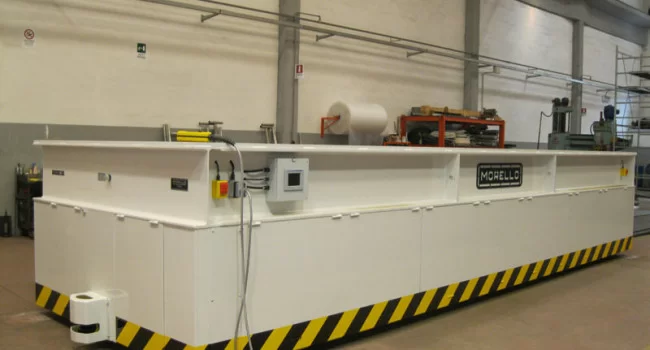
In the demanding world of heavy industrial logistics, the delivery of a 220-ton automatic self-propelled rail cart represents a significant advancement for steel manufacturing operations. MORELLO‘s latest innovation—the SBR-8R model —exemplifies cutting-edge engineering designed specifically for handling massive steel coils in major production facilities. This sophisticated transportation solution combines robust load capacity with precision control systems, enabling seamless movement of extraordinary weights across rail systems within complex manufacturing environments.
For operational directors and industrial engineers working in steel production, this automated rail cart technology offers transformative capabilities that streamline material handling workflows, enhance safety protocols, and optimize production efficiency. As manufacturing facilities continue to seek more intelligent, reliable solutions for moving heavy loads, MORELLO’s rail cart systems stand at the forefront of industrial material handling innovation, delivering performance that meets the exacting standards of today’s most demanding industrial applications.
Advanced engineering behind the 220 ton automatic self-propelled rail cart
The development of a 220-ton automatic self-propelled rail cart represents a remarkable achievement in industrial engineering. MORELLO’s approach to designing these massive transport systems combines mechanical robustness with sophisticated control technology to create machines capable of handling extraordinary weight demands with precision.
At the core of these rail carts lies a reinforced steel frame structure, engineered to distribute weight evenly while maintaining structural integrity under extreme loads. The propulsion system incorporates high-torque electric motors specifically calibrated for gradual acceleration and deceleration—critical for safely moving loads exceeding 200 tons without creating dangerous momentum.
What truly distinguishes these systems is their advanced automation architecture. Each cart features:
- Multi-zone sensor arrays that constantly monitor position, speed, and load distribution
- Proprietary control algorithms that adjust power delivery based on real-time operational conditions
- Redundant safety systems with emergency stop capabilities at multiple points
- Remote monitoring interfaces allowing operators to oversee movements from safe distances
The engineering challenge extends beyond mere weight capacity. These rail carts must operate reliably in harsh industrial environments, including extreme temperatures, metal particulates, and constant vibration. This requires specialized material selection, sealed electronic components, and industrial-grade connectivity solutions that maintain system integrity despite challenging conditions.
The integration of these engineering elements creates a transportation platform that not only moves extraordinary weights but does so with a level of control and safety that transforms how steel manufacturers approach material handling logistics.
Technical specifications and operational capabilities
The SBR-8R represents MORELLO’s flagship offering in rail-based material handling solutions, specifically engineered for steel production environments. With dimensions of 8000 x 2500 mm, this platform provides substantial surface area for accommodating oversized steel coils while maintaining a footprint that navigates effectively through production facilities.
The 220-ton capacity places this model among the most robust industrial transport solutions available, capable of handling multiple steel coils simultaneously or individual components of exceptional weight. The platform’s weight distribution system automatically adjusts to maintain stability regardless of load positioning, a critical feature when transporting asymmetrical materials.
Power delivery in the SBR-8R comes from multiple synchronized electric drive units, offering several operational advantages over traditional systems. The electric propulsion provides precise speed control—from crawl speeds of just 0.1 meters per minute for precise positioning to standard transport speeds of up to 20 meters per minute when moving between production stations.
The rail guidance system incorporates hardened steel wheels with specialized profiles designed specifically for industrial rail applications. This configuration delivers exceptional durability while minimizing maintenance requirements in demanding production environments.
Control systems feature both onboard manual operation and remote command capabilities, allowing integration with broader manufacturing execution systems. The interface includes intuitive visual feedback on load status, position accuracy, and system diagnostics, enabling operators to maintain operational awareness throughout transport cycles.
Perhaps most impressively, the SBR-8R achieves positioning accuracy within 5mm at full load—a remarkable achievement for a system handling 220 tons that enables seamless integration with automated production processes where precision is paramount.
Benefits of automatic rail carts for heavy loads in steel manufacturing
Steel manufacturing facilities face unique challenges when moving massive components throughout their production process. The implementation of automatic self-propelled rail carts delivers transformative advantages that directly impact operational efficiency, worker safety, and production economics.
From a productivity perspective, these automated systems dramatically reduce material transfer times between production stages. Traditional overhead crane systems require complex rigging procedures and specialized operators for each movement. In contrast, rail-based solutions enable continuous material flow with minimal human intervention, reducing transfer times by up to 60% in typical steel production environments.
Worker safety represents perhaps the most compelling benefit. By removing personnel from direct interaction with massive steel coils during transport, facilities report significant reductions in workplace incidents. The automated movement patterns eliminate human error factors that historically contribute to accidents when handling loads exceeding 200 tons.
The economic impact extends beyond mere efficiency gains. Steel manufacturers implementing these systems report substantial reductions in product damage during internal logistics operations. When moving delicate steel coils with specialized surface treatments, the precise acceleration and deceleration profiles of automated rail carts prevent the microdamage that occurs with less sophisticated handling methods.
Facility infrastructure also benefits from rail-based transport solutions. The distributed weight loading across rail systems reduces point loading on facility floors compared to wheeled transport alternatives. This extends the service life of production buildings while minimizing maintenance requirements for transport pathways.
Additionally, the predictable movement patterns of automated rail carts facilitate production planning with unprecedented accuracy, allowing operational managers to optimize workflows around reliable material transfer timelines that remain consistent regardless of shift changes or operator experience levels.
Implementation challenges and solutions for rail cart systems
Integrating 220-ton automatic self-propelled rail carts into existing steel manufacturing operations presents several significant challenges that require strategic planning and specialized expertise to overcome. Understanding these challenges—and their proven solutions—is essential for operational directors considering these systems.
The first major hurdle involves physical infrastructure requirements. Rail systems must be precisely installed with exacting tolerances to ensure smooth operation under extreme loads. For facilities transitioning from other transport methods, this often necessitates substantial floor reinforcement and precision grading work. MORELLO addresses this through comprehensive site assessment services that identify optimal rail pathways utilizing existing structural elements wherever possible, minimizing facility disruption.
Integration with existing production control systems presents another complex challenge. Modern steel plants typically operate multiple digital control environments that must interface seamlessly with new transport systems. The solution lies in MORELLO’s open-architecture control systems, which feature standardized communication protocols and customizable interface layers specifically designed to connect with legacy manufacturing execution systems.
Employee adoption represents a frequently underestimated implementation challenge. Transitioning from manual transport methods to automated systems requires significant operational adjustments. Successful implementations incorporate comprehensive training programs focusing not just on system operation but on new workflow patterns that maximize the technology’s benefits.
Perhaps most critically, maintaining production during implementation poses substantial logistical challenges. MORELLO has developed phased implementation methodologies specifically for steel manufacturing environments, allowing sections of transport infrastructure to be upgraded sequentially while maintaining critical production flows through temporary pathways and carefully orchestrated transition periods.
These implementation strategies have proven effective across diverse manufacturing environments, enabling smooth transitions to automated rail cart systems while minimizing production disruptions during the transition process.
Future innovations in heavy-duty material handling technology
As industrial manufacturing continues to evolve, the technology driving heavy-duty material handling systems is advancing rapidly. Several emerging innovations promise to further transform how facilities move massive loads like those handled by the 220-ton automatic self-propelled rail carts.
Artificial intelligence integration represents perhaps the most transformative development on the horizon. Next-generation rail cart systems will incorporate machine learning algorithms that optimize movement patterns based on historical data, predicting maintenance needs before failures occur and automatically adjusting operating parameters to maximize energy efficiency under varying load conditions.
Enhanced power management systems are also emerging as a crucial development area. New energy storage technologies enable regenerative braking systems that capture kinetic energy during deceleration phases, storing it for future acceleration cycles. This innovation significantly reduces power consumption—a critical factor as manufacturing facilities increasingly focus on sustainability metrics alongside productivity measures.
Sensor fusion technology is advancing to provide unprecedented situational awareness for automated transport systems. By combining multiple sensor types—including lidar, computer vision, and pressure mapping—future rail carts will maintain comprehensive real-time awareness of their operational environment, enabling safe operation in increasingly dynamic manufacturing settings where humans and automated systems work in closer proximity.
Wireless control architecture represents another frontier, eliminating the need for physical control connections and enabling more flexible reconfiguration of transport pathways. These systems utilize industrial-hardened wireless protocols with redundant communication channels to maintain reliability in electromagnetically noisy industrial environments.
MORELLO continues investing in these emerging technologies, working closely with leading steel manufacturers to develop next-generation transport solutions that will further enhance productivity, safety, and efficiency in heavy industrial environments, maintaining their position at the forefront of material handling innovation.
Transforming heavy industry with advanced rail cart technology
The delivery of MORELLO’s 220-ton automatic self-propelled rail cart represents far more than just equipment acquisition—it signals a fundamental shift in how steel manufacturers approach internal logistics challenges. These sophisticated transport solutions combine extraordinary load capacity with precision control systems that enhance safety, efficiency, and production reliability. As manufacturing facilities continue evolving toward more automated and integrated operations, the role of advanced material handling systems becomes increasingly central to maintaining competitive advantage in global markets.
For operational directors and industrial engineers evaluating their heavy load handling strategies, MORELLO’s expertise in custom-engineered transport solutions offers a pathway to significant operational improvements. Our engineering team specializes in analyzing your specific material flow requirements and developing tailored solutions that address your unique challenges.
Ready to transform your heavy material handling capabilities? Contact MORELLO’s engineering team today to discuss how our custom rail cart solutions can optimize your production efficiency while enhancing workplace safety.