
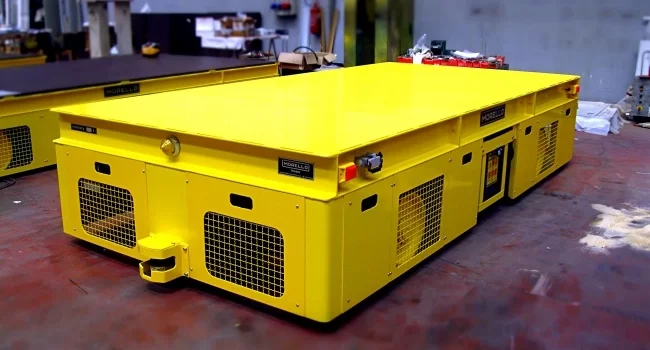
In today’s fast-evolving industrial landscape, the 20-ton AGV cart with automated navigation technology represents a significant advancement in material handling solutions. These sophisticated vehicles combine robust load capacity with intelligent guidance systems, enabling the autonomous transport of heavy materials across manufacturing facilities, warehouses, and production plants. Designed to handle substantial weights while navigating complex environments with precision, these AGV carts eliminate the need for manual operation in challenging industrial settings. MORELLO’s cutting-edge 20-ton AGV carts feature state-of-the-art navigation technologies that can follow predetermined paths using various guidance methods, including colored tape systems that allow for flexible route modifications without hardware or software changes. This innovative approach to heavy material transport not only enhances operational efficiency but also significantly improves workplace safety by reducing human intervention in hazardous environments. For operations managers and industrial engineers seeking reliable solutions for moving substantial loads, these automated vehicles deliver exceptional performance while adapting to specific facility requirements.
The evolution of AGV carts with automated navigation technology
Automated Guided Vehicles (AGVs) have transformed material handling operations across industrial sectors, with the 20-ton AGV cart representing a significant milestone in this technological evolution. These robust machines have progressed from simple line-following carts to sophisticated autonomous systems capable of navigating complex industrial environments while carrying substantial loads.
The development of heavy-duty AGVs began with basic wire-guided systems that required permanent infrastructure modifications. Modern AGV carts with automated navigation technology now utilize multiple guidance methods, including laser guidance, vision systems, and colored tape technology that allows for flexible pathway adjustments without structural changes to facilities.
What makes these advanced systems particularly valuable for industrial applications is their ability to combine substantial weight capacity with precise navigation. The integration of sophisticated sensors, AI-driven obstacle detection, and real-time path optimization has enabled these machines to operate safely alongside human workers while maintaining operational efficiency.
The control systems have similarly evolved from basic programmable logic controllers to integrated fleet management platforms that coordinate multiple AGVs simultaneously. This advancement allows manufacturing facilities to deploy several AGV carts that work in harmony, avoiding collisions and optimizing material flow throughout production areas.
For industrial engineers and operations managers, this evolution means greater flexibility in facility design and improved adaptability to changing production requirements—a critical advantage in today’s dynamic manufacturing environments.
Technical specifications and capabilities of heavy-duty AGV transfer systems
Heavy-duty AGV transfer systems, like MORELLO’s 20-ton AGV cart, are engineered with precise technical specifications to handle substantial industrial loads while maintaining operational excellence. Understanding these specifications is crucial for facility planners and operations managers considering automated material handling solutions.
The load capacity of these systems typically ranges from 15 to 40 tons, with specialized models capable of supporting even greater weights. The 20-ton AGV cart represents an optimal balance between substantial carrying capacity and maneuverability in confined spaces. Platform dimensions generally measure between 3,000 and 4,500 mm in length and 1,800 to 2,200 mm in width, allowing for transportation of oversized components.
Power systems in modern heavy-duty AGVs utilize high-capacity batteries that enable continuous operation for 4-8 hours before requiring recharging. AC brushless motors drive these systems, providing superior torque and precise speed control—typically 20-30 meters per minute when fully loaded. This combination delivers the power necessary for moving substantial weights while maintaining energy efficiency.
What truly distinguishes advanced AGV systems is their steering capability. Dual-axle steering allows for exceptional maneuverability in tight spaces, with some models achieving turning radiuses as small as 3 meters despite their substantial size. This feature is particularly valuable in manufacturing environments where space optimization is critical.
Control systems incorporate multiple redundant safety features, including obstacle detection sensors, emergency stop mechanisms, and sophisticated pathway monitoring. These systems work in concert to ensure safe operation around personnel and valuable equipment, making them suitable for integration into active production environments.
Colored guide tape technology: flexible pathways for industrial automation
Among the various navigation methodologies employed in 20-ton AGV carts with automated navigation technology, colored guide tape systems stand out for their remarkable flexibility and cost-effectiveness. This approach utilizes specialized optical sensors mounted on the AGV that detect and follow colored tape applied directly to the facility floor, creating defined pathways for automated material transport.
The primary advantage of this technology lies in its adaptability. Unlike embedded wire guidance systems that require significant infrastructure modifications, colored tape pathways can be installed, modified, or removed in hours rather than days. This enables operations managers to rapidly reconfigure material flow paths in response to changing production requirements without disrupting ongoing operations.
The implementation process is straightforward: high-contrast tape (typically in colors that stand out against the floor surface) is applied along desired routes. The AGV’s optical sensors detect the tape’s edges and center the vehicle along the path with precision typically within ±10mm, even when carrying a full 20-ton load. Modern systems can recognize multiple tape colors, allowing for programmed behaviors at intersections or decision points.
Maintenance requirements are minimal compared to other guidance technologies. While the tape must be kept reasonably clean and replaced if damaged, the system doesn’t require the complex infrastructure of magnetic or inductive wire guidance. This translates to reduced downtime and lower long-term operational costs.
For facilities with evolving layouts or those implementing automation incrementally, colored guide tape technology provides an ideal entry point into advanced material handling automation without committing to permanent infrastructure changes. This approach allows companies to experience the benefits of 20-ton AGV carts while maintaining the flexibility to adapt as operational needs evolve.
Dual-axle steering and battery management in advanced AGV systems
The maneuverability of a 20-ton AGV cart is significantly enhanced through dual-axle steering systems. Unlike conventional vehicles that steer only from the front axle, advanced AGVs employ steering capabilities on both axles, creating remarkable mobility despite their substantial size and load capacity.
This dual-axle configuration enables the AGV to navigate tight corners and narrow aisles with precision that would be impossible with single-axle steering. The system utilizes independent AC brushless motors for each steering mechanism, allowing for coordinated movements that can reduce turning radius by up to 40% compared to traditional designs. For manufacturing facilities with space constraints, this capability transforms previously inaccessible areas into viable automated transport routes.
Equally important to the operational efficiency of heavy-duty AGVs is their battery management system. Modern 20-ton AGV carts incorporate sophisticated power management technologies that extend operational time while minimizing charging requirements. The integration of skid-based automatic charging systems represents a particularly innovative approach—the AGV simply positions itself over a charging skid on the floor, establishing connection without manual cable attachment.
This contactless charging methodology eliminates connector wear issues and removes the need for human intervention in the charging process. The system monitors battery condition in real-time, optimizing charging cycles to maximize battery lifespan while ensuring sufficient power reserves for operational demands. Some advanced models incorporate opportunity charging capabilities, allowing them to automatically seek charging stations during idle periods.
Together, these dual-axle steering and intelligent battery management systems create AGVs that combine exceptional maneuverability with extended operational availability—critical factors for maintaining production flow in demanding industrial environments where downtime must be minimized.
Advantages of heavy-duty AGV carts in manufacturing environments
Implementing 20-ton AGV carts with automated navigation technology delivers substantial operational benefits across diverse manufacturing sectors. These advantages extend beyond simple automation to create transformative improvements in production efficiency, safety, and cost management.
From an operational perspective, heavy-duty AGV systems provide consistent, predictable material movement that integrates seamlessly with production schedules. Unlike manual transport methods that depend on operator availability and skill, automated carts maintain precise timing and positioning, reducing production bottlenecks and improving overall workflow continuity. This predictability allows for just-in-time material delivery that reduces inventory buffer requirements and optimizes floor space utilization.
The safety advantages are equally compelling. By removing human operators from the task of moving massive loads through busy facilities, companies significantly reduce workplace injury risks. Modern AGVs incorporate multiple safety systems including proximity sensors, automatic speed reduction in congested areas, and emergency stop capabilities that exceed the reaction capabilities of human operators.
From a financial perspective, the return on investment typically materializes through multiple channels:
- Labor optimization – Redirecting skilled personnel from repetitive transport tasks to value-adding activities
- Damage reduction – Eliminating human error in material handling, protecting both products and facility infrastructure
- Extended operational hours – Enabling 24/7 material movement without shift limitations
- Reduced maintenance costs – Preventing the accelerated wear associated with human-operated equipment
Perhaps most significantly, heavy-duty AGV implementation creates operational data streams that provide unprecedented visibility into material movement patterns. This information enables continuous optimization of facility layouts and production sequencing, creating a foundation for ongoing efficiency improvements that extend well beyond the initial automation benefits.
Transforming industrial material handling with advanced automation
The 20-ton AGV cart with automated navigation technology represents a significant advancement in industrial material handling, combining robust load capacity with intelligent guidance systems that adapt to changing operational requirements. By implementing these sophisticated solutions, manufacturing facilities can achieve new levels of efficiency, safety, and process reliability while reducing operational costs.
MORELLO‘s expertise in custom-designed heavy-duty AGV systems ensures that each implementation addresses the specific challenges of your industrial environment. Our engineering team works closely with clients to develop tailored solutions that integrate seamlessly with existing operations while providing a foundation for future automation initiatives.
Ready to explore how automated material handling can transform your manufacturing operations? Contact MORELLO today to discuss your specific requirements and discover how our advanced AGV solutions can optimize your heavy material transport processes. Our specialists will help you identify the right configuration to maximize your return on investment while enhancing workplace safety and operational efficiency.