
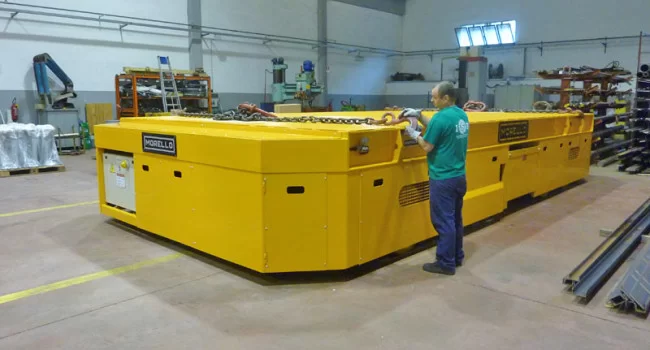
In today’s industrial landscape, the efficient movement of heavy loads represents a critical operational challenge. Self-propelled trailers for heavy-duty loads have emerged as the definitive solution for transporting massive components across manufacturing facilities, construction sites, and logistics centers. These specialized vehicles combine exceptional load capacity with remarkable maneuverability, enabling the safe transportation of components weighing up to 180 tons and beyond. Unlike conventional towing systems that require separate tractors, self-propelled trailers integrate the propulsion system directly into the transport platform, creating a unified solution that maximizes control and efficiency.
For engineers and operations directors in energy, construction, and heavy manufacturing sectors, these advanced transport systems represent not merely equipment but strategic assets that fundamentally transform material handling capabilities. MORELLO’s self-propelled trailers exemplify how innovative engineering can solve the most demanding industrial transport challenges with precision, reliability, and operational excellence.
Engineering excellence: how self-propelled trailers handle extreme loads
The engineering behind self-propelled trailers for heavy-duty loads represents a pinnacle of industrial design innovation. These specialized vehicles incorporate multiple technological systems working in harmony to move extraordinary weights with precision and safety. At the core of their capability is a robust structural framework designed with advanced stress distribution principles, allowing loads of up to 180 tons to be supported without compromising the trailer’s integrity.
The propulsion systems in these trailers utilize high-torque motors connected to specially designed wheel assemblies. This configuration creates exceptional traction while maintaining maneuverability even under extreme weight conditions. The power transmission is engineered with redundant systems to ensure operational reliability, a critical factor when handling valuable industrial components.
What truly distinguishes premium self-propelled trailers is their sophisticated weight distribution technology. Load-sensing hydraulic systems automatically adjust to maintain optimal balance and ground pressure, preventing structural stress and ensuring smooth transport across varying surfaces. This adaptive capability makes these trailers particularly valuable in manufacturing environments where floor loading limitations must be strictly observed.
The steering mechanisms deserve special attention, as they overcome the inherent challenges of directing massive weights. Multi-axle coordination systems allow for precise movements in confined spaces, while electronic control interfaces give operators fingertip command over these powerful machines. This combination of structural strength, distributed propulsion, and intelligent control systems is what enables self-propelled trailers to handle loads that would overwhelm conventional transport equipment.
Key features of industrial self-propelled trailers for heavy-duty applications
Industrial self-propelled trailers designed for heavy-duty applications incorporate several distinctive features that set them apart from conventional transport equipment. Understanding these key elements helps operations directors and engineers select the optimal solution for their specific material handling challenges.
The load capacity of these specialized trailers ranges from 30 to over 200 tons, with MORELLO’s advanced models capable of handling loads up to 180 tons with exceptional stability. This capacity is supported by reinforced chassis designs and specialized load-bearing components manufactured from high-tensile steel alloys.
A defining characteristic is the integrated power system. Unlike towed trailers, self-propelled units feature onboard power plants—either electric battery systems or diesel engines—that drive multiple independently controlled wheels. This configuration eliminates the need for separate towing vehicles while providing superior maneuverability in confined spaces.
The control systems represent another crucial feature. Modern heavy load self-propelled trailers for industrial transport incorporate programmable logic controllers (PLCs) with intuitive human-machine interfaces. These systems allow for precise speed control, load monitoring, and directional adjustments, often with wireless remote operation capabilities for enhanced operator safety.
Customizable platforms address specific transport requirements. These may include adjustable width decks, specialized securing mechanisms, tilt functions, or integration with existing plant systems. The adaptability of self-propelled trailers makes them particularly valuable in manufacturing environments where loads vary in size, shape, and weight distribution.
Finally, advanced safety features include emergency stop systems, overload protection, speed governors, and obstacle detection technology—all essential when moving massive components through active industrial environments.
Battery-powered vs. diesel self-propelled trailers: choosing the right solution
When selecting self-propelled trailers for heavy-duty loads, the power source represents a critical decision point with significant operational implications. The choice between battery-electric and diesel-powered systems depends on several factors specific to your industrial environment and transport requirements.
Battery-powered trailers, like MORELLO’s 180-ton electric model, offer compelling advantages for indoor operations. They produce zero emissions at the point of use, making them ideal for enclosed manufacturing facilities where air quality is a concern. The absence of exhaust fumes also makes them suitable for industries with strict contamination controls, such as electronics or pharmaceutical manufacturing. These electric systems operate with significantly reduced noise levels, creating a more comfortable working environment and reducing noise pollution.
Conversely, diesel-powered self-propelled trailers excel in scenarios requiring extended operational periods without downtime. They eliminate battery charging cycles and can be quickly refueled, making them suitable for multi-shift operations or applications where continuous availability is essential. Diesel systems typically deliver higher torque at lower speeds, which can be advantageous when initiating movement with extremely heavy loads. They also perform reliably in outdoor environments and variable temperature conditions where battery performance might be affected.
Operational range represents another consideration. Battery systems typically provide 6-8 hours of operation before requiring recharging, while diesel units can run continuously with fuel replenishment. However, modern lithium-ion battery technologies are narrowing this gap with faster charging capabilities and extended cycle life.
The long-term cost analysis also differs significantly. Battery systems generally have higher initial acquisition costs but lower operational expenses, while diesel systems offer lower upfront investment but higher lifetime fuel and maintenance costs. Your specific application requirements will ultimately determine which power system delivers the optimal balance of performance, economics, and environmental impact.
Customization options for self-propelled trailers for industrial transport
The true value of self-propelled trailers for heavy-duty loads often lies in their adaptability to specific industrial requirements. MORELLO’s engineering approach centers on creating customized transport solutions that precisely match the unique challenges of each application environment. This customization extends across multiple design elements to optimize performance for particular load types and operational scenarios.
Platform configuration represents a primary customization area. Load platforms can be engineered with specific dimensions, surface treatments, and securing mechanisms designed for particular component shapes. For manufacturing environments handling machine tools, specialized cradles with precise fitment points ensure stability during transport. Similarly, the nuclear industry requires platforms with radiation-resistant materials and specialized containment features.
Directional control systems offer another customization pathway. While standard self-propelled trailers typically provide forward/reverse movement with turning capability, specialized applications may benefit from omnidirectional movement systems. These sophisticated steering arrangements allow the trailer to move sideways, rotate in place, or follow complex paths—particularly valuable when positioning large components in confined spaces.
Integration capabilities with existing factory systems represent an increasingly important customization area. Modern heavy load self-propelled trailers can incorporate communication interfaces that connect with manufacturing execution systems (MES) or warehouse management software. This connectivity enables automated routing, scheduling, and operational monitoring that enhances overall facility efficiency.
Specialized attachments further extend functionality. These may include hydraulic lifting mechanisms, tilting platforms, roll-on/roll-off capabilities, or custom fixtures designed for specific component geometries. When transporting sensitive equipment, customized suspension systems can be incorporated to minimize vibration and protect valuable cargo during movement.
Through these customization pathways, self-propelled trailers transform from general transport equipment into precisely engineered solutions for specific industrial material handling challenges.
Real-world applications of MORELLO’s self-propelled trailer technology
MORELLO’s self-propelled trailers have transformed heavy material handling across diverse industrial sectors, with each application showcasing the versatility and precision of these specialized transport systems. Examining these implementations provides valuable insight into how this technology solves complex logistical challenges.
In heavy manufacturing, MORELLO’s 180-ton self-propelled trailers have revolutionized machine tool transport within production facilities. These battery-powered units navigate between machining stations, assembly areas, and testing facilities, maintaining precise positioning control despite carrying massive metal components. The elimination of overhead cranes for these movements has significantly reduced production bottlenecks while enhancing workplace safety.
The energy sector utilizes these trailers for transporting turbine components, generator assemblies, and transformer units. The precise maneuverability allows positioning of these critical components within millimeter tolerances—essential when aligning connection points during installation. The self-contained power systems eliminate the need for separate towing equipment in restricted spaces like power generation facilities.
Aerospace manufacturing benefits from MORELLO’s customized trailers designed for aircraft component transport. These specialized units feature adaptive securing systems that protect delicate components while providing the structural support needed for large airframe sections. The electric propulsion systems eliminate contamination concerns in clean manufacturing environments.
In precast concrete production, self-propelled trailers transport massive structural elements from casting beds to curing areas and ultimately to shipping zones. The distributed load-bearing design prevents damage to freshly produced components, while precise control systems navigate through production facilities with minimal clearance.
The nuclear industry employs specially shielded MORELLO’s trailers for moving sensitive equipment and materials within controlled environments. These applications demonstrate how self-propelled trailer technology can be adapted to the most demanding safety and regulatory requirements while maintaining exceptional performance characteristics.
Advancing industrial material handling with MORELLO’s engineered solutions
Self-propelled trailers for heavy-duty loads represent a critical advancement in industrial material handling technology, enabling operations that would be impossible with conventional transport methods. As manufacturing and construction processes continue to evolve toward larger components and more complex assemblies, the need for specialized transport solutions becomes increasingly vital. MORELLO’s engineering philosophy—combining robust load capacity with precise control systems and customizable configurations—delivers the performance and reliability demanded by today’s most challenging industrial environments.
Whether your operation requires battery-powered units for indoor use, diesel systems for extended operation, or specialized configurations for unique load profiles, MORELLO’s design expertise ensures an optimal solution for your specific requirements. The proven performance of these self-propelled systems across diverse industrial applications demonstrates their value as strategic assets that enhance productivity, safety, and operational efficiency.
Ready to transform your heavy material handling capabilities? Explore MORELLO’s complete range of self-propelled trailers and discover how our customized transport solutions can address your most challenging movement requirements.