
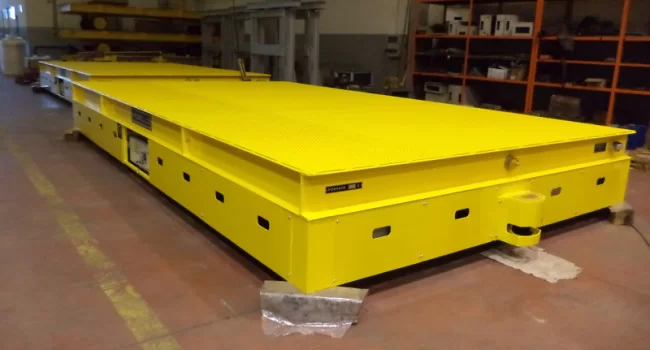
In modern manufacturing environments where efficiency, sustainability, and reliability are paramount, battery-powered industrial trailers for rail-bound material transport represent a significant advancement in heavy load handling technology. These specialized vehicles combine the precision of rail-guided movement with the autonomy of battery power, offering industrial operations a versatile solution for transporting substantial loads across manufacturing facilities, foundries, and production plants.
MORELLO’s industrial rail trailers exemplify this innovation, designed specifically to handle loads up to 60 tons while maintaining precise control and operational flexibility. As industries worldwide seek to optimize their material handling processes while reducing their environmental footprint, these battery-powered transport systems deliver a compelling alternative to traditional towing mechanisms, diesel-powered equipment, and manual handling operations. For facility managers and industrial engineers facing complex material movement challenges, understanding the capabilities and applications of these specialized trailers opens new possibilities for operational efficiency.
The engineering behind battery-powered industrial trailers for rail-bound material transport
Battery-powered indusrial trailers for rail-bound material transport represent a sophisticated integration of mechanical engineering, power management systems, and industrial design principles. These specialized vehicles operate on fixed rail tracks while drawing power from onboard battery systems, eliminating the need for external power sources or tethered connections during operation.
The core engineering components that make these systems effective include high-capacity lithium-ion battery packs, precision electric drive motors, and intelligent control systems. MORELLO’s engineering approach focuses on creating a balanced power-to-weight ratio that maximizes operational runtime while maintaining the structural integrity needed to transport loads up to 60 tons.
The propulsion system typically features direct-drive electric motors connected to specially designed wheel assemblies that maintain optimal contact with the rail infrastructure. This configuration ensures smooth acceleration, precise speed control, and sufficient torque for moving heavy industrial loads even on slight inclines.
What sets advanced industrial rail trailers apart is their regenerative braking capability, which recovers energy during deceleration and returns it to the battery system. This engineering feature significantly extends operational runtime between charging cycles and contributes to the overall efficiency of the material transport system.
Power management systems continuously monitor battery status, motor performance, and load conditions to optimize energy consumption while preventing system overload. These intelligent systems provide operators with real-time data on remaining operational capacity and maintenance requirements, ensuring reliable performance in demanding industrial environments.
Key advantages of rail-mounted battery trailers for heavy industrial loads
Rail-mounted battery trailers deliver substantial operational benefits that make them increasingly preferred for heavy industrial material transport. These specialized vehicles combine the predictability of rail guidance with the flexibility of self-powered operation, creating a uniquely efficient solution for manufacturing environments.
The most significant advantage is the exceptional precision in load positioning. By utilizing rail infrastructure, these trailers follow predetermined paths with millimeter accuracy, critical when transporting sensitive components or positioning heavy loads in confined spaces. This precision reduces the risk of collisions with infrastructure and improves overall facility safety.
Environmental considerations also favor battery-powered industrial rail trailers. With zero local emissions, they improve air quality within enclosed manufacturing spaces while reducing the overall carbon footprint of material handling operations. The absence of combustion engines also eliminates noise pollution, creating better working conditions for facility personnel.
From a maintenance perspective, battery-powered systems offer substantial advantages over hydraulic or combustion alternatives. With fewer moving parts and no hydraulic fluids, these systems require less frequent maintenance interventions and reduce the risk of fluid leaks that could contaminate production environments or finished products.
Perhaps most compelling is the operational autonomy these systems provide. Unlike tethered electric systems or manually operated equipment, battery-powered rail trailers can operate continuously across shifts without refueling or recharging delays when implemented with appropriate battery management strategies. This continuous operation capability translates directly to improved throughput and better utilization of manufacturing capacity.
Applications and industries benefiting from rail-bound battery transport systems
Rail-bound battery transport systems have found their niche across numerous heavy industries where predictable, high-capacity material movement is essential. The versatility of these systems makes them valuable assets in multiple industrial contexts.
In foundries and metal processing facilities, these trailers excel at transporting molten metal, finished castings, and heavy dies between production stations. The rail guidance system ensures predictable movement patterns in environments where precision is critical and where the consequences of collisions could be catastrophic. MORELLO’s implementation of 60-ton capacity industrial rail trailers in foundry environments demonstrates how these systems can handle extreme loads while maintaining operational safety.
Precast concrete manufacturing represents another ideal application. The substantial weight of concrete elements and the need to move them between curing areas, finishing stations, and loading zones makes rail-mounted battery trailers particularly valuable. Their ability to handle loads exceeding 50 tons while maintaining precise positioning capabilities significantly reduces the risk of product damage during transport.
Heavy equipment manufacturing facilities utilize these systems to move partially assembled components between workstations. The rail infrastructure provides a defined transport network throughout the facility, while the battery-powered propulsion eliminates the need for external power connections that could impede workflow flexibility.
Wind energy component production facilities particularly benefit from rail-bound systems when moving massive turbine components. The combination of high load capacity and precise positioning capabilities makes these trailers ideal for transporting nacelles, hubs, and other oversized components through the production process with minimal risk of damage.
Technical specifications and customization options for maximum efficiency
When evaluating battery-powered industrial trailers for rail-bound material transport, understanding the technical specifications and available customization options is essential for selecting a solution that aligns perfectly with operational requirements. MORELLO’s SBA-4R series exemplifies how these systems can be tailored to specific industrial needs.
The core technical parameters that define these systems include:
- Load capacity: Ranging from 20 to 60+ tons, with structural reinforcements and power systems scaled accordingly
- Platform dimensions: Customizable to accommodate specific load profiles, with standard configurations starting at 6000 x 3500 mm
- Battery specifications: High-capacity lithium-ion or advanced lead-acid systems sized to provide 8-12 hours of continuous operation
- Drive system: Electric motors delivering variable torque output based on load requirements and operational conditions
- Control interface: Options ranging from simple manual controls to sophisticated remote operation systems and integration with facility management software
Beyond these fundamental specifications, manufacturers like MORELLO offer extensive customization options to address specific operational challenges. These include specialized load securing mechanisms, integrated weighing systems for load verification, and environmental protection packages for outdoor operation.
Advanced control systems can incorporate obstacle detection, programmable movement paths, and integration with broader facility automation infrastructure. For operations requiring maximum uptime, quick-change battery systems allow for immediate power source replacement without extended downtime for recharging.
The rail interface itself can be customized to accommodate existing infrastructure or designed as part of a comprehensive material handling solution, with options for curved paths, switches, and elevation changes to navigate complex facility layouts.
Implementation strategies and ROI considerations for industrial facilities
Implementing industrial rail trailers requires strategic planning to maximize return on investment while minimizing operational disruption. Successful implementation begins with a comprehensive assessment of current material flow patterns, identifying bottlenecks and inefficiencies that could be addressed through rail-guided transport solutions.
Facility managers should consider a phased implementation approach, starting with high-impact transport routes where the precision and reliability of rail-bound systems would deliver immediate operational benefits. This targeted deployment allows for validation of the technology’s effectiveness before expanding to broader facility applications.
When calculating ROI, it’s essential to look beyond the initial equipment acquisition costs to consider the comprehensive financial impact. Direct labor savings from reduced manual handling operations typically represent the most visible benefit, but secondary advantages often deliver even greater value. These include reduced product damage during transport, decreased maintenance costs compared to conventional transport equipment, and improved production throughput from more consistent material delivery.
Energy efficiency contributes significantly to the long-term ROI equation. Battery-powered rail systems typically consume 30-40% less energy than equivalent diesel-powered transport solutions, with this differential increasing as energy costs rise. Additionally, the elimination of fossil fuel infrastructure and storage requirements reduces both capital and compliance costs.
Working with an experienced provider like MORELLO ensures that implementation challenges are anticipated and addressed proactively. Their engineering teams can assist with rail infrastructure design, integration with existing production systems, and operator training programs to accelerate the transition to rail-bound transport. This collaborative approach minimizes implementation risks while accelerating the realization of operational benefits and financial returns.
Advancing industrial transport efficiency with rail-bound battery systems
Battery-powered industrial trailers for rail-bound material transport represent a significant advancement in industrial handling technology, combining the precision of rail guidance with the flexibility of autonomous power. As manufacturing facilities face increasing pressure to optimize operations while reducing environmental impact, these specialized transport solutions deliver compelling advantages across multiple industries. From foundries and metal processing to precast concrete and heavy equipment manufacturing, the ability to move substantial loads with precision and reliability translates directly to improved operational efficiency and reduced production costs.
MORELLO’s expertise in designing and manufacturing customized material handling solutions positions them as an ideal partner for facilities considering the implementation of battery-powered industrial rail trailers. Their engineering team works closely with clients to develop transport systems precisely tailored to specific operational requirements and facility constraints. To explore how battery-powered rail transport solutions could transform your material handling operations, contact MORELLO’s engineering team for a personalized consultation and discover the potential efficiency gains waiting to be unlocked in your facility.