
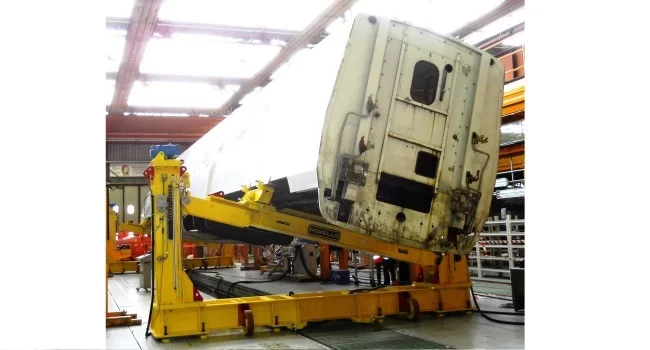
In the railway industry, accurate load measurement is critical for operational safety, efficiency, and compliance with regulatory standards. The railway wagon weighing system represents a significant advancement in how railway companies monitor and manage load distribution. MORELLO, a global leader in customized machinery for heavy load handling, has developed an innovative solution that precisely measures a wagon’s barycenter during curve navigation.
This breakthrough technology addresses one of the most challenging aspects of railway operations: maintaining stability and safety while transporting heavy loads through varying track geometries. By providing real-time, accurate measurements, this system helps prevent derailments, reduces track wear, and optimizes fuel efficiency. For industrial engineers and operations directors in the transportation sector, this technology offers unprecedented control over railway cargo management, ensuring both safety and operational excellence.
The engineering behind railway wagon weighing systems
Railway wagon weighing systems represent a sophisticated integration of mechanical engineering, sensor technology, and data analytics. The fundamental principle involves measuring the force exerted by a wagon on the track, translating this into accurate weight measurements even as the vehicle moves through curved sections. Unlike static weighing platforms, a railway wagon weighing system for accurate load measurement must account for dynamic forces, including lateral pressure, centrifugal force, and weight shifts during movement.
The engineering challenge lies in creating a system that can distinguish between the actual cargo weight and the various forces generated during train movement. MORELLO’s innovative approach incorporates precision load cells strategically positioned to capture multi-directional force data. These sensors communicate with advanced algorithms that filter out movement-related variations, providing real-time barycenter calculations.
What makes this system particularly valuable is its ability to measure weight distribution across the entire wagon while in motion. This dynamic measurement capability helps identify potential stability issues before they become critical safety concerns. The system can detect when load shifts occur during transit, allowing operators to take corrective action before reaching critical curve sections where derailment risks increase significantly.
Key components of the measurement technology
The effectiveness of MORELLO’s railway wagon weighing system for accurate load measurement stems from its carefully engineered components working in harmony. Each element plays a crucial role in ensuring measurement precision under dynamic conditions.
The system architecture consists of several integrated technologies:
- High-precision load cells: Strain gauge-based sensors capable of measuring both vertical and lateral forces with accuracy within 0.1% of the applied load, even during movement.
- Accelerometers and gyroscopes: Motion-sensing devices that track the wagon’s orientation, speed, and acceleration through curves, providing contextual data for measurement calibration.
- Central processing unit: A ruggedized computer system that analyzes inputs from all sensors, applies compensation algorithms, and calculates real-time barycenter coordinates.
- Wireless communication module: Transmits processed data to operators and control systems, enabling immediate response to detected weight distribution issues.
- Environmental compensation system: Adjusts for temperature variations, track irregularities, and other external factors that could affect measurement accuracy.
What distinguishes MORELLO’s solution is its integration of these components into a cohesive system that maintains accuracy regardless of track conditions. The technology employs advanced filtering algorithms to distinguish between actual load-related forces and transient effects from movement, ensuring that operators receive reliable data about wagon loading status even during complex maneuvers through curved sections.
Achieving accuracy in dynamic load measurement
The greatest challenge in developing a railway wagon weighing system lies in maintaining precision while the wagon is in motion, particularly when navigating curves. Static weighing is relatively straightforward, but dynamic measurement introduces numerous variables that can compromise accuracy.
MORELLO’s engineers have overcome these challenges through several innovative approaches. First, the system employs multiple measurement points rather than relying on a single sensor location. This distributed sensing network creates a comprehensive force profile across the entire wagon, enabling more precise barycenter calculations.
Another critical factor is the sampling rate. The system captures data at frequencies exceeding 1000 Hz, allowing it to detect subtle weight shifts that occur in milliseconds. This high-frequency sampling is paired with sophisticated signal processing that filters out vibration noise while preserving genuine weight distribution data.
Calibration represents another essential aspect of accuracy. The system continuously self-calibrates by comparing measurements against known reference points and making micro-adjustments to compensate for environmental factors like temperature fluctuations and track irregularities.
Perhaps most impressive is the system’s ability to account for centrifugal forces during curve navigation. By incorporating the track’s radius of curvature, train velocity, and wagon geometry into its algorithms, the system can distinguish between actual load distribution and the apparent weight shift caused by centripetal acceleration. This allows operators to identify genuinely problematic load configurations that might lead to derailment, while ignoring normal physics-based weight shifts that pose no safety risk.
Implementation challenges and solutions in railway environments
Deploying a railway wagon weighing system in real-world railway operations presents numerous challenges beyond the technical aspects of measurement accuracy. Railway environments are notoriously harsh, with extreme temperature variations, constant vibration, exposure to moisture, and electromagnetic interference from traction systems.
MORELLO addressed these implementation challenges by developing ruggedized hardware with IP67-rated enclosures that protect sensitive electronics from dust and water ingress. The system components undergo extensive shock and vibration testing to ensure reliability under the constant movement experienced in railway operations.
Power management represents another significant challenge. The system incorporates an independent power supply with backup capabilities, ensuring continuous operation even during main power fluctuations. Energy harvesting technologies, including vibration-to-electricity converters, supplement the power requirements, extending operational time between maintenance intervals.
Integration with existing railway infrastructure demanded careful consideration. MORELLO’s engineers designed the system to be retrofitted to standard wagon configurations without requiring extensive modifications. The non-invasive installation process minimizes downtime and preserves the structural integrity of the wagon.
Data security and reliability concerns were addressed through redundant communication channels and encryption protocols. The system maintains local data storage with automatic synchronization to central servers when connectivity is available, preventing data loss during communication interruptions.
Perhaps most importantly, MORELLO worked closely with railway operators to develop intuitive interfaces that present complex measurement data in actionable formats. This human-centered design approach ensures that the technical sophistication of the system translates into practical operational benefits.
Future applications and benefits for the transportation industry
The railway wagon weighing system developed by MORELLO represents just the beginning of a technological evolution in railway operations. As this technology matures, its applications will extend far beyond basic load measurement, transforming multiple aspects of the transportation industry.
Predictive maintenance stands as one of the most promising applications. By continuously monitoring load distribution patterns, the system can detect subtle changes that might indicate developing structural issues in wagons before they become visible through traditional inspection methods. This predictive capability could dramatically reduce maintenance costs while improving fleet availability.
The technology also opens new possibilities for route optimization. With precise understanding of load distribution across entire trains, operators can make data-driven decisions about speed restrictions through specific track sections, potentially increasing average speeds while maintaining safety margins. This optimization could significantly improve delivery times and operational efficiency.
From a regulatory perspective, the system provides unprecedented documentation capabilities. Transportation companies can demonstrate compliance with weight restrictions and load distribution requirements through comprehensive digital records, streamlining inspections and reducing compliance-related delays.
Perhaps most significantly, this technology could influence future wagon design. The detailed data collected about dynamic load behavior will help engineers develop next-generation rolling stock with optimized weight distribution characteristics, potentially allowing for increased carrying capacity without compromising safety.
As integration with other smart transportation systems progresses, this weighing technology will become a crucial component in fully digitalized railway operations, contributing to the broader transformation toward more efficient, safer, and more sustainable freight transportation.
Advancing railway operations through precision measurement
The railway wagon weighing system for accurate load measurement represents a significant advancement in railway safety and operational efficiency. By providing real-time data on load distribution during curve navigation, MORELLO has addressed one of the most challenging aspects of railway transportation. This innovative technology not only enhances safety by preventing potential derailments but also optimizes operational parameters, reduces maintenance costs, and extends infrastructure lifespan through proper load management.
As the transportation industry continues to evolve toward greater efficiency and sustainability, technologies like this weighing system will play an increasingly vital role. For railway operators seeking to enhance their operational capabilities while maintaining the highest safety standards, implementing advanced measurement solutions is no longer optional—it’s essential for competitive advantage.
Ready to transform your railway operations with cutting-edge load measurement technology? Explore MORELLO’s custom heavy load handling solutions and discover how our engineering expertise can address your most challenging transportation requirements.