
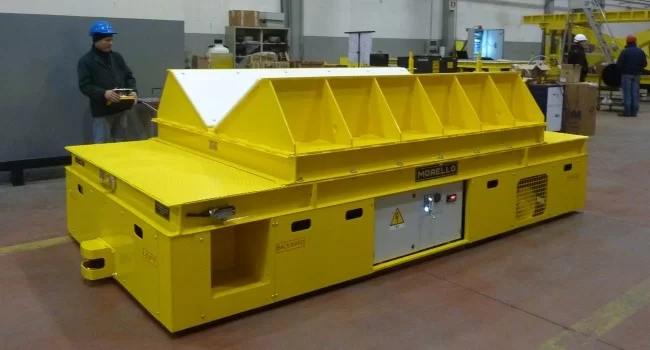
In modern industrial environments where precision, safety, and efficiency are paramount, battery-operated transporters with load cells represent a technological breakthrough for material handling operations. These sophisticated vehicles combine autonomous mobility with precise weight measurement capabilities, creating an intelligent solution for moving heavy loads across manufacturing facilities, warehouses, and construction sites. MORELLO’s advanced battery-operated transporters integrate cutting-edge load cell technology to provide real-time weight monitoring, preventing operational hazards and optimizing load management. This integration of power systems and measurement technology delivers unprecedented control and safety for industrial operations handling critical components, dies, coils, and oversized materials. As industries worldwide face increasing pressure to improve safety standards while maximizing productivity, these specialized transporters offer a comprehensive solution that addresses both challenges simultaneously, transforming how heavy materials are moved in complex industrial settings.
The evolution of battery-operated transporters in industrial environments
Industrial material handling has undergone a remarkable transformation from manual processes to sophisticated automated solutions. Battery-operated transporters represent a significant milestone in this evolution, offering mobility without the constraints of power cables or the emissions associated with combustion engines. The integration of electric propulsion systems has enabled these vehicles to operate in sensitive indoor environments while maintaining the power necessary to move substantial loads.
Early battery transporters faced limitations in operational duration and load capacity, but technological advancements have dramatically improved their capabilities. Modern lithium-ion battery systems have replaced older lead-acid configurations, providing extended operational periods of up to 8 hours on a single charge while reducing maintenance requirements and charging times. This shift has made battery-operated transporters viable alternatives to traditional diesel-powered equipment even in demanding industrial applications.
The most significant advancement has been the integration of intelligent control systems with the power train. Contemporary battery-operated transporters feature AC motors with variable frequency drives that deliver precise speed control and improved energy efficiency. These systems can now handle loads exceeding 25 tons while maintaining maneuverability in confined spaces – a combination previously unattainable with conventional equipment.
This evolution continues as manufacturers like MORELLO develop transporters with regenerative braking systems that recover energy during deceleration, further extending battery life and operational efficiency in industrial environments where continuous material movement is essential.
Understanding load cell technology in heavy-duty material handling
Load cells represent the critical sensing component in modern industrial transporters, functioning as precision weight measurement devices that transform mechanical force into measurable electrical signals. In battery-operated transporters designed for heavy-duty applications, these sophisticated sensors are strategically positioned to monitor load distribution and total weight in real-time.
The technology operates on strain gauge principles, where deformation of an elastic element under pressure creates a change in electrical resistance proportional to the applied force. This resistance change, though minimal, is amplified and processed by integrated electronics to provide accurate weight readings with precision typically within 0.1% of the total capacity.
Most industrial transporters employ multiple load cells—typically four positioned at each corner of the loading platform—to enable:
- Precise weight distribution analysis across the transporter’s platform
- Overload prevention through automated system lockouts when weight exceeds rated capacity
- Center of gravity monitoring to prevent tipping during movement
- Dynamic load compensation during acceleration and deceleration phases
The integration of load cell data with the transporter’s control systems creates an intelligent handling solution that continuously evaluates operational safety parameters. This technological marriage enables the vehicle to make autonomous decisions, such as refusing to initiate movement when detecting an unbalanced or excessive load, thereby preventing potential accidents before they occur.
Advanced models feature temperature-compensated load cells that maintain accuracy across varying environmental conditions, ensuring consistent performance in facilities where temperature fluctuations are common.
Safety innovations: how integrated load cells prevent operational hazards
The integration of load cells into battery-operated transporters has revolutionized industrial safety protocols by creating intelligent systems that actively prevent hazardous situations. These precision instruments work continuously within the transporter’s operational framework, establishing multiple layers of protection for both operators and valuable cargo.
MORELLO’s advanced transporters exemplify this safety-first approach through systems that automatically prevent movement initiation when detecting loads exceeding rated capacity. This preemptive intervention eliminates one of the most common causes of industrial accidents – attempting to transport loads beyond equipment specifications. The system provides operators with immediate feedback through visual and audible alerts, clearly indicating when load adjustments are necessary.
Beyond simple weight monitoring, these sophisticated transporters employ dynamic stability analysis during operation. The load cells continuously monitor weight distribution across the platform, detecting potential instability that could lead to tipping or load shifting. When detecting unbalanced loads or unsafe weight distribution, the system can automatically reduce speed or completely halt movement until the situation is corrected.
This technology pairs seamlessly with other safety innovations such as anti-tilting systems in remote controllers, which detect operator falls or improper handling by monitoring controller orientation. When the controller exceeds a 45-degree tilt angle, the system immediately stops the transporter, preventing accidents that might result from uncontrolled movement.
Further enhancing operational safety, laser scanners mounted on the transporter’s perimeter create dynamic safety zones that adjust based on speed and direction, automatically slowing or stopping the vehicle when obstacles or personnel enter protected areas. This comprehensive approach to safety demonstrates how load cell technology has evolved beyond simple weight measurement to become an integral component of industrial risk management.
Customization options for battery-operated transporters with load cells
The industrial versatility of battery-operated transporters with load cells stems from their extensive customization capabilities, allowing manufacturers like MORELLO to tailor solutions for specific operational environments. These adaptable systems can be configured to address unique material handling challenges across diverse industries while maintaining the core benefits of weight monitoring and safety management.
Platform dimensions represent a primary customization point, with widths and lengths engineered to accommodate specific load types—from standardized pallets to irregularly shaped components. Load capacity calibration allows for precise configuration between 5 and 50 tons, with corresponding adjustments to the drive system, frame structure, and load cell sensitivity to ensure optimal performance under designated weight conditions.
Superstructure adaptations transform the basic transporter platform into specialized handling equipment through additions such as:
- Removable V-saddles with nylon coverings provide secure transport for cylindrical objects like coils, pipes, and rolls while protecting surface finishes.
- Adjustable clamps and positioning systems enable secure handling of dies and molds with varying dimensions.
- Custom fixtures designed for industry-specific components ensure proper weight distribution and secure transport of irregularly shaped loads.
Drive system customization allows for speed adjustments based on facility requirements, with options ranging from precise low-speed movement at 5 meters per minute to higher-efficiency transport at 20+ meters per minute. Wheel configurations can be adapted to facility conditions, with rubber tires for general applications and polyurethane options for environments requiring non-marking or static-dissipative properties.
For specialized environments, MORELLO offers ATEX/IEC Ex/Hazloc conforming models with intrinsically safe electrical systems and spark-resistant components, enabling safe operation in potentially explosive atmospheres while maintaining the critical load cell functionality that ensures operational safety.
Practical applications across diverse industrial sectors
Battery-operated transporters with load cells have proven their versatility across numerous industrial environments, each benefiting from the precise weight monitoring and enhanced safety these systems provide. In automotive manufacturing facilities, these transporters have become essential for die handling operations, where they safely move heavy stamping dies weighing up to 25 tons between storage areas and press lines. The integrated load cells ensure proper weight distribution during transport, preventing costly damage to these precision tools.
The steel industry leverages these transporters for coil handling, utilizing specialized V-saddle attachments to securely cradle and transport rolled steel products. The real-time weight monitoring capabilities are particularly valuable in this application, as coil weights can vary significantly and must be precisely tracked for inventory management and process control.
In aerospace manufacturing, where components are both exceptionally valuable and weight-sensitive, these transporters provide the precision handling required for moving large airframe sections and tooling equipment. The ability to monitor load distribution helps prevent deformation of components during transport, maintaining critical tolerances.
Energy sector applications include the movement of turbine components and generator assemblies in power plant construction and maintenance operations. The battery-powered nature of these transporters makes them ideal for indoor use where emissions must be avoided, while their load cell systems ensure safe handling of these high-value assets.
Precast concrete manufacturing facilities employ these systems to transport finished elements weighing several tons. The precise weight measurement capabilities help verify product specifications while ensuring safe transport from production areas to curing and storage locations. In all these applications, the combination of autonomous mobility and weight monitoring creates a versatile solution that enhances both operational efficiency and workplace safety.
Transforming industrial material handling through intelligent transport solutions
Battery-operated transporters with load cells represent the convergence of mobility, precision measurement, and safety engineering in modern industrial environments. By integrating weight monitoring capabilities with autonomous movement systems, these specialized vehicles deliver unprecedented control over material handling operations while significantly reducing workplace hazards. The ability to detect overloading, imbalance, and other potential safety issues before movement begins creates a proactive safety approach that protects both valuable materials and personnel. As industries continue to seek solutions that enhance efficiency without compromising safety, these intelligent transport systems offer a compelling answer to complex material handling challenges.
MORELLO‘s expertise in designing and manufacturing customized material handling solutions positions us as an ideal partner for industries seeking to optimize their heavy load transportation processes. Whether you’re managing dies in automotive manufacturing, handling steel coils, or transporting oversized components, our engineering team can develop a battery-operated transporter with load cell technology tailored to your specific requirements. Contact our specialists today to discuss how our innovative transport solutions can transform your material handling operations.