
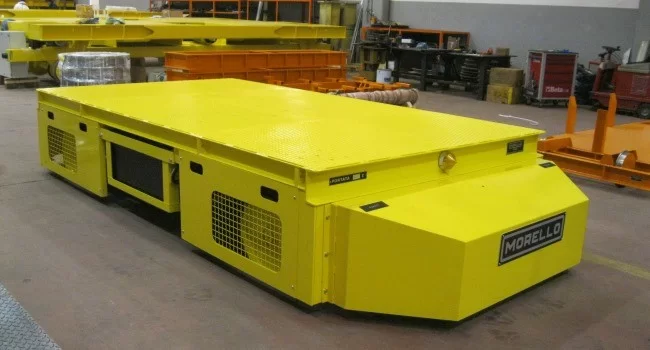
In today’s fast-paced industrial environments, efficient material handling is crucial for maintaining productivity and operational excellence. Self-propelled battery trailers represent a revolutionary advancement in the transportation of heavy loads across manufacturing facilities, warehouses, and construction sites. These specialized vehicles combine robust load capacity with unprecedented maneuverability, offering a sustainable alternative to traditional diesel-powered equipment.
MORELLO‘s cutting-edge self-propelled battery trailers are engineered to handle loads up to 10 tons with precision and reliability, while maintaining impressive travel speeds of up to 30 meters per minute. By eliminating the need for separate towing vehicles and reducing the environmental impact associated with conventional material handling equipment, these battery-powered solutions are transforming how industrial operations approach the movement of heavy materials. Whether navigating tight spaces in complex facilities or transporting critical components across expansive work areas, these innovative trailers deliver exceptional performance while prioritizing safety and efficiency.
The evolution of self-propelled battery trailers in industrial material handling
Industrial material handling has undergone a remarkable transformation since the introduction of self-propelled battery trailers. These specialized vehicles emerged as manufacturers sought more efficient alternatives to traditional towing methods that required separate power units and multiple operators. The early models represented a significant leap forward, combining transportation and power systems into unified platforms capable of independent operation.
As technology progressed, these trailers evolved from basic transport vehicles to sophisticated material handling solutions. The integration of advanced battery technologies marked a pivotal moment, extending operational times while reducing charging requirements. Simultaneously, control systems advanced from simple manual interfaces to complex electronic systems offering precision movement and enhanced safety features.
MORELLO has been at the forefront of this evolution, continuously refining self-propelled battery trailer designs to meet increasingly demanding industrial requirements. The company’s innovations have focused on three critical areas:
- Load capacity optimization – Engineering solutions that maximize weight-bearing capabilities while maintaining maneuverability
- Energy efficiency improvements – Developing power management systems that extend operational duration
- Control interface refinement – Creating intuitive operator experiences that reduce training requirements and improve productivity
Today’s self-propelled battery trailers for industrial material handling represent the culmination of decades of engineering advancement. They offer unprecedented flexibility in manufacturing environments, distribution centers, and construction sites where the movement of heavy components requires both power and precision.
Technical specifications and capabilities
Modern battery-powered trailers for heavy-duty operations represent the pinnacle of industrial material handling technology. MORELLO’s self-propelled battery trailers exemplify this advancement with impressive technical specifications that meet demanding industrial requirements. The SGAI VC model, for instance, offers a substantial 10-ton capacity on a platform measuring 3,500 x 2,000 mm, providing ample space for oversized components while maintaining structural integrity under significant loads.
The propulsion systems in these specialized vehicles deliver remarkable performance metrics. With travel speeds reaching 30 meters per minute, these trailers efficiently transport materials across large manufacturing facilities without sacrificing precision during positioning operations. The battery systems powering these units utilize advanced lithium-ion or enhanced lead-acid technologies, delivering extended operational periods between charging cycles.
Control systems have evolved significantly, incorporating features such as:
- Directional versatility stands as a defining characteristic of premium self-propelled battery trailers. Many models offer multi-directional movement capabilities, including forward/reverse operation, lateral movement, and even diagonal travel patterns. This omnidirectional functionality proves invaluable when navigating congested workspaces or positioning loads in confined areas.
- Safety features integrate seamlessly into the design architecture, with emergency stop functions, obstacle detection systems, and operator presence controls. Load stability mechanisms actively monitor weight distribution and automatically compensate for shifting centers of gravity during transport operations. These intelligent systems work in concert to maintain safe operating conditions even when handling asymmetrical or dynamically changing loads.
Key advantages of battery-powered trailers
Battery-powered trailers for heavy-duty operations offer substantial benefits over traditional material handling solutions, creating measurable value for industrial facilities. Perhaps the most significant advantage lies in their operational independence. Unlike conventional tractor-trailer systems that require dedicated towing vehicles, self-propelled battery trailers function as standalone units, eliminating equipment redundancies and reducing fleet management complexity.
The environmental impact represents another compelling advantage. These electric-powered systems produce zero local emissions during operation, contributing to cleaner working environments and supporting corporate sustainability initiatives. The noise reduction compared to diesel-powered alternatives creates healthier workspaces and enables communication without the constant background noise of combustion engines.
From a financial perspective, battery-powered trailers deliver compelling long-term value. The initial investment is offset by reduced operational costs, with electricity typically costing significantly less than diesel fuel for equivalent work performed. Maintenance requirements also decrease substantially with fewer moving parts and elimination of complex transmission systems. The simplified drivetrain architecture means fewer components subject to wear, translating to increased uptime and extended service intervals.
Maneuverability within confined spaces represents a practical advantage that directly impacts productivity. The compact design and precision control systems allow operators to navigate tight aisles and position loads exactly where needed without multiple adjustment maneuvers. This spatial efficiency translates directly to time savings during material transport operations.
Finally, these systems demonstrate remarkable adaptability across diverse industrial applications. Whether in manufacturing, logistics, construction, or energy production, self-propelled battery trailers for industrial material handling provide consistent performance while accommodating unique operational requirements.
Implementation strategies for integrating self-propelled trailers into existing workflows
Integrating self-propelled battery trailers into established industrial environments requires thoughtful planning and strategic implementation. The transition begins with a comprehensive workflow analysis to identify critical material movement pathways and potential bottlenecks. This assessment should examine current transportation methods, load characteristics, facility layout constraints, and operational timing requirements.
Facility preparation often necessitates infrastructure modifications to support battery-powered equipment. Installing charging stations at strategic locations ensures continuous operations while minimizing downtime. Floor surfaces may require evaluation and potential reinforcement to accommodate the concentrated weight distribution of fully loaded trailers. Doorways, corridors, and turning areas should be measured against trailer specifications to verify adequate clearance throughout all transport routes.
Personnel training represents a crucial implementation component. Operators require instruction not only in basic control functions but also in optimized movement patterns that maximize efficiency. Maintenance staff need specialized training in electric drivetrain diagnostics, battery management, and preventive maintenance protocols. This knowledge transfer ensures the organization can fully leverage the technology’s capabilities while maintaining operational readiness.
A phased deployment approach typically yields the best results. Beginning with a single trailer in a limited operational area allows for process refinement before expanding to full implementation. This measured strategy provides opportunities to document best practices, address unforeseen challenges, and demonstrate tangible benefits to stakeholders throughout the organization.
MORELLO provides comprehensive implementation support, including site assessment services, customized trailer configurations, and training programs tailored to specific industrial applications. This collaborative approach ensures that self-propelled battery trailers for industrial material handling integrate seamlessly into existing workflows while maximizing return on investment.
Future innovations in material handling technology
The evolution of self-propelled material handling technology continues at an accelerating pace, with several emerging innovations poised to further transform industrial operations. Battery technology stands at the forefront of this advancement, with research focused on increasing energy density while reducing weight and charging times. Next-generation power systems promise to extend operational periods significantly, potentially enabling multiple shifts without recharging requirements.
Autonomous navigation capabilities represent another exciting frontier. While current self-propelled battery trailers for industrial material handling require operator guidance, semi-autonomous and fully autonomous systems are under active development. These technologies incorporate advanced sensor arrays, machine learning algorithms, and real-time decision-making capabilities to navigate complex industrial environments without human intervention.
Integration with facility management systems offers substantial efficiency gains. Future trailers will likely communicate directly with inventory management platforms, production scheduling software, and predictive maintenance systems. This interconnectivity enables optimized material flow based on real-time production demands and resource availability.
Modular design approaches are gaining traction, allowing a single base platform to adapt to diverse material handling requirements through interchangeable components. This flexibility enables companies to configure trailers for specific tasks without investing in multiple specialized units, maximizing equipment utilization while minimizing capital expenditures.
MORELLO maintains its position at the innovation forefront through continuous research and development investments. The company’s engineering teams collaborate with industry partners to identify emerging needs and develop solutions that anticipate future challenges in battery-powered trailer technology for heavy-duty operations. This forward-looking approach ensures that MORELLO’s self-propelled battery trailers will continue setting industry standards for performance, reliability, and technological advancement.
Revolutionizing industrial operations with advanced material handling solutions
Self-propelled battery trailers represent a transformative approach to industrial material handling, offering unprecedented efficiency, environmental benefits, and operational flexibility. As manufacturing and logistics operations continue to evolve, these specialized vehicles provide a powerful solution for transporting heavy loads with precision and reliability. MORELLO’s commitment to engineering excellence ensures that each self-propelled battery trailer delivers exceptional performance while meeting the unique requirements of demanding industrial environments.
The transition from traditional towing methods to self-propelled technology creates measurable advantages in productivity, safety, and cost-effectiveness. By eliminating the need for separate towing vehicles and reducing environmental impact, these battery-powered solutions align perfectly with modern industrial objectives of operational efficiency and sustainability.
Ready to transform your material handling capabilities? Explore MORELLO’s complete range of customized self-propelled battery trailers and discover how our innovative solutions can optimize your heavy-duty operations while reducing operational costs and environmental impact.