
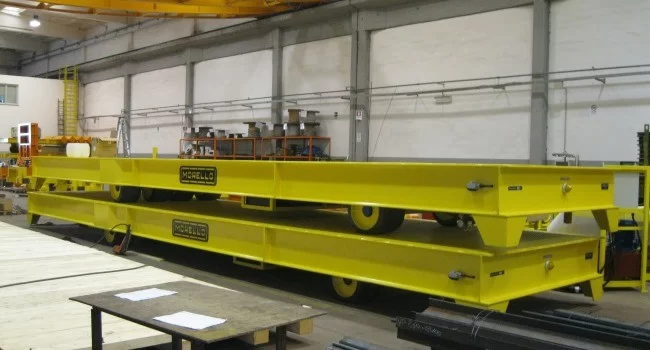
Industrial facilities across the globe face increasingly complex material handling challenges that demand innovative solutions. MORELLO’s tyred battery transfer cars represent the pinnacle of heavy-duty material transport technology, designed specifically for operations where conventional handling equipment falls short. These specialized vehicles combine robust engineering with advanced battery technology to deliver exceptional performance in demanding environments.
The delivery of tyred battery transfer cars for industrial use has become a critical component of operational strategy for companies in sectors ranging from energy production to manufacturing and logistics. With load capacities of up to 40 tons and custom-engineered platforms designed for specific cargo requirements, these self-propelled units offer unparalleled versatility and efficiency.
What sets these machines apart is their ability to navigate tight spaces with precision while maintaining full control over heavy loads. The integration of electric propulsion systems not only reduces environmental impact but also eliminates the operational constraints associated with combustion engines in indoor facilities. This technological advancement has opened new possibilities for streamlining production flows and optimizing space utilization in industrial settings where every square foot represents significant value.
Advanced engineering behind tyred battery transfer cars
The technological sophistication of MORELLO’s tyred battery transfer cars represents decades of engineering excellence and continuous innovation. At the core of these industrial vehicles is a meticulously designed power management system that optimizes energy consumption while delivering consistent torque across varying load conditions. The proprietary battery technology provides extended operational cycles between charges, addressing one of the most significant challenges in heavy-duty electric vehicle applications.
The structural integrity of these transfer cars is ensured through advanced stress analysis and reinforced chassis design, allowing for the even distribution of massive loads across the platform. The integration of high-durability tyres specifically engineered for industrial applications provides the necessary traction and stability while minimizing floor damage—a crucial consideration in manufacturing facilities with specialized flooring.
Control systems represent another area where MORELLO’s engineering shines. The precision steering mechanisms employ sophisticated algorithms that calculate optimal turning radiuses based on load distribution, ensuring safe maneuverability in confined spaces. Operators benefit from intuitive control interfaces that provide real-time feedback on vehicle performance metrics, including battery status, load distribution, and system diagnostics.
Perhaps most impressive is the modular design philosophy that allows for the integration of various attachments and customized handling solutions without compromising the core performance of the vehicle. This adaptability ensures that each delivery of tyred battery transfer cars for industrial use can be tailored to the specific operational requirements of the client.
Global deployment and industry applications
MORELLO’s delivery of tyred battery transfer cars for industrial use spans across continents, addressing diverse operational challenges in multiple sectors. In Southeast Asia, major energy companies have implemented these specialized vehicles to transport heavy components within power generation facilities, where the combination of weight capacity and precision maneuvering proves invaluable. The recent deployment of six 40-ton capacity electronic self-propelled trailers to Indonesia exemplifies this global reach, providing essential material handling capabilities for critical infrastructure development.
In the aerospace industry, these transfer cars facilitate the movement of aircraft components through production lines, where the tolerance for positioning errors is measured in millimeters despite loads weighing several tons. The automotive manufacturing sector similarly benefits from these solutions, with assembly plants utilizing the vehicles to transport chassis components, stamping dies, and completed vehicle sections between production stations.
Heavy precast concrete manufacturing represents another significant application area, where the mobility of massive structural elements presents unique challenges. MORELLO’s transfer cars enable the efficient movement of beams, columns, and wall sections throughout production facilities and staging areas, dramatically reducing handling time and labor requirements.
The steel industry has likewise embraced these solutions for transporting coils, plates, and beams within processing facilities. The ability to navigate through complex plant layouts while carrying loads that often exceed conventional handling equipment capacities has made these specialized vehicles indispensable assets for metallurgical operations around the world.
Performance advantages in heavy load handling
When evaluating the delivery of tyred battery transfer cars for industrial use, performance metrics reveal significant operational advantages compared to traditional material handling methods. The self-propelled nature of these vehicles eliminates the need for separate towing equipment, reducing both capital investment and operational complexity. This integrated approach allows for more efficient space utilization within facilities where every square meter impacts productivity.
The electric drive systems provide instant torque delivery, enabling smooth acceleration even under maximum load conditions. This characteristic is particularly valuable when initiating movement of static loads that would otherwise require oversized combustion-powered equipment. The precision control extends to braking systems as well, with regenerative technology that not only enhances safety but also returns energy to the battery system during deceleration phases.
Load stability during transport represents another critical performance dimension. MORELLO’s transfer cars incorporate sophisticated weight distribution systems that maintain the center of gravity within optimal parameters regardless of cargo positioning. This capability significantly reduces the risk of tipping or load shifting during movement—a common concern when handling oversized components in manufacturing environments.
The omnidirectional steering options available on select models provide unmatched maneuverability in congested industrial settings. This feature allows operators to navigate through complex facility layouts without the wide turning radius requirements typical of conventional transport solutions. For operations where positioning accuracy directly impacts production efficiency, this capability translates to measurable productivity gains and reduced handling times across the manufacturing process.
Customization capabilities for specific operational needs
The delivery of tyred battery transfer cars for industrial use rarely follows a one-size-fits-all approach. MORELLO’s engineering philosophy centers on adaptability, with each vehicle designed to address the unique operational parameters of its intended environment. Platform dimensions represent the most visible customization aspect, with options ranging from compact designs for space-constrained facilities to expansive surfaces exceeding 12 meters in length for oversized component transport.
Load capacity customization extends beyond simple weight ratings to include specialized weight distribution systems for irregularly shaped cargo. Engineers analyze the specific materials being transported to develop optimal support structures that prevent deformation while maintaining mobility. This approach proves particularly valuable when handling delicate components that require precise positioning despite their substantial mass.
Control interfaces can be tailored to integrate with existing facility management systems, enabling real-time tracking of material movement throughout the production process. Remote operation capabilities can be implemented for environments where operator safety concerns exist, allowing for precise control from protected locations. For facilities with multiple transfer cars, fleet management systems can coordinate movements to optimize workflow and prevent congestion in high-traffic areas.
Environmental adaptations represent another crucial customization category. Vehicles destined for hazardous environments can incorporate explosion-proof electrical systems, while those operating in temperature-controlled facilities feature specialized components designed for consistent performance in extreme conditions. The modular architecture of MORELLO’s transfer cars allows these modifications to be implemented without compromising the core reliability that industrial operations demand.
Sustainability and future trends in industrial mobility solutions
The environmental advantages of battery-powered transfer cars extend well beyond the elimination of direct emissions. The delivery of tyred battery transfer cars for industrial use represents a significant step toward sustainable manufacturing practices, with each implementation reducing the carbon footprint of material handling operations. These electric vehicles produce zero local emissions during operation, creating healthier working environments while simultaneously reducing ventilation requirements in enclosed facilities.
Energy efficiency metrics reveal that electric transfer systems typically convert more than 85% of stored energy into useful work, compared to roughly 30% for diesel-powered alternatives. This efficiency translates directly to reduced operational costs while minimizing environmental impact. The integration of regenerative braking systems further enhances this advantage by recapturing energy during deceleration phases that would otherwise be lost as heat.
Looking forward, emerging battery technologies promise to extend operational ranges while reducing charging times—two factors that currently represent the primary limitations for electric industrial vehicles. MORELLO’s engineering teams actively explore advanced lithium chemistry variants and solid-state battery technologies that could potentially double energy density while enhancing safety profiles for heavy industrial applications.
The integration of semi-autonomous and fully autonomous capabilities represents another frontier in the evolution of these systems. Sensor fusion technologies combining lidar, computer vision, and inertial measurement units are being developed to enable predictive navigation through dynamic industrial environments. These advancements will eventually allow transfer cars to optimize their own routes, coordinate with other vehicles, and adapt to changing facility conditions without human intervention—further enhancing safety and operational efficiency.
Transforming industrial mobility through innovative engineering
The delivery of tyred battery transfer cars for industrial use continues to transform how global enterprises approach material handling challenges. MORELLO‘s commitment to engineering excellence, combined with deep industry expertise, has positioned these specialized vehicles as essential tools for operations where conventional solutions fall short. From energy production facilities in Southeast Asia to manufacturing plants across Europe and the Americas, these robust transport systems enable the safe, efficient movement of critical components while supporting sustainability initiatives.
As industrial requirements evolve, so too will the capabilities of these sophisticated machines. The integration of advanced battery technologies, autonomous navigation features, and enhanced customization options will further extend their utility across diverse operational environments. For operations managers and industrial engineers facing complex material handling challenges, MORELLO’s expertise in battery-powered transfer carts offers a proven pathway to optimized workflow, enhanced safety, and improved operational efficiency.